2026 USA Men’s World Team analysis
Team chosen (INCYMI)
Frederick Richard
Shane Wiskus
Danila Leykin
Kameron Nelson
Patrick Hoopes
Let’s walk through the selection criteria
To automatically be selected, a gymnast has to win the all-around and be top three on three events. No one did that in this competition.
The next step is to run three types of team scenarios and look at the top 5 teams in each. If the top team is made up of the exact same athletes in all three scenarios, that will be the team, unless that team contains a mix where only three athletes can compete on an apparatus in prelims.
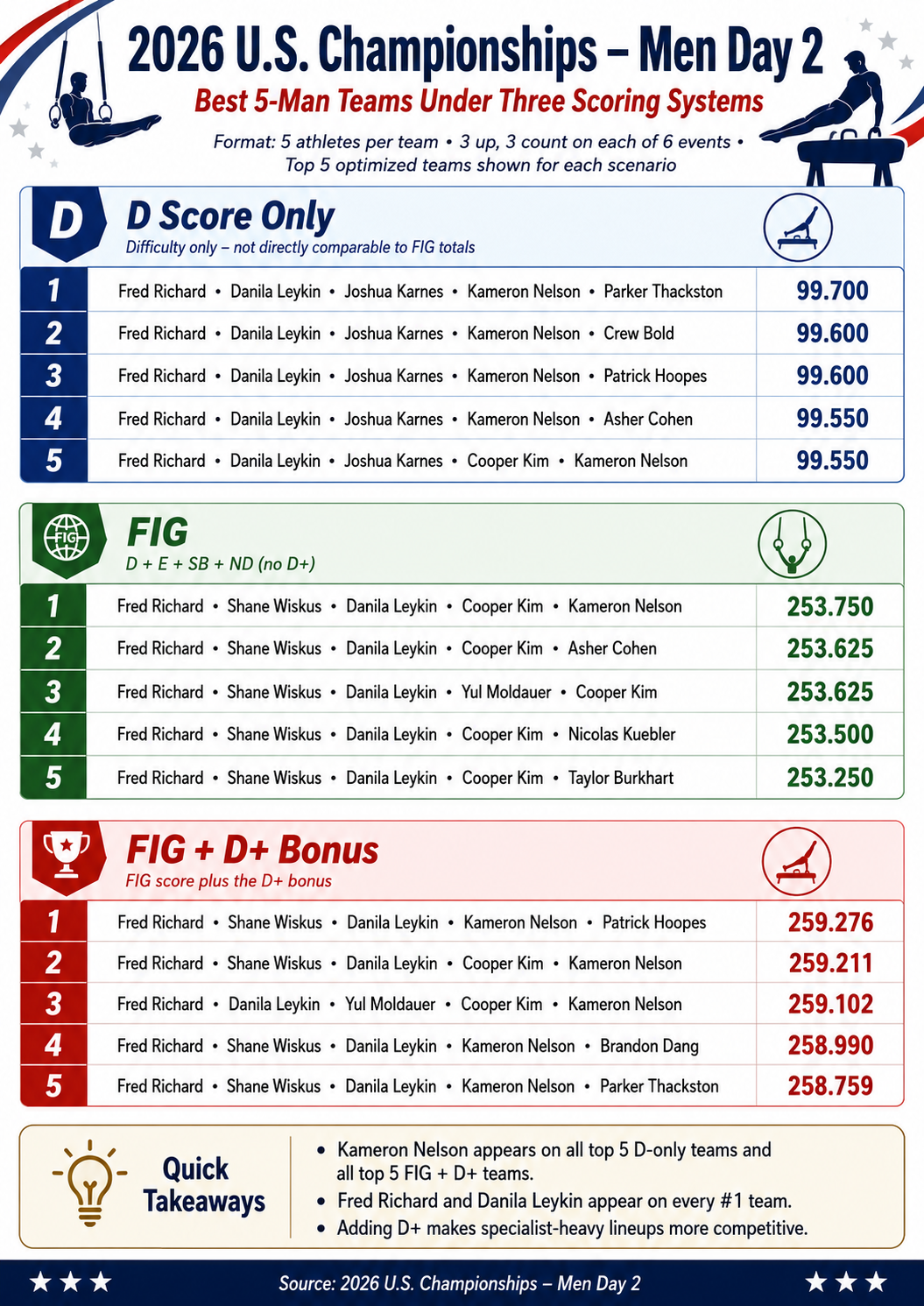
These don’t match.
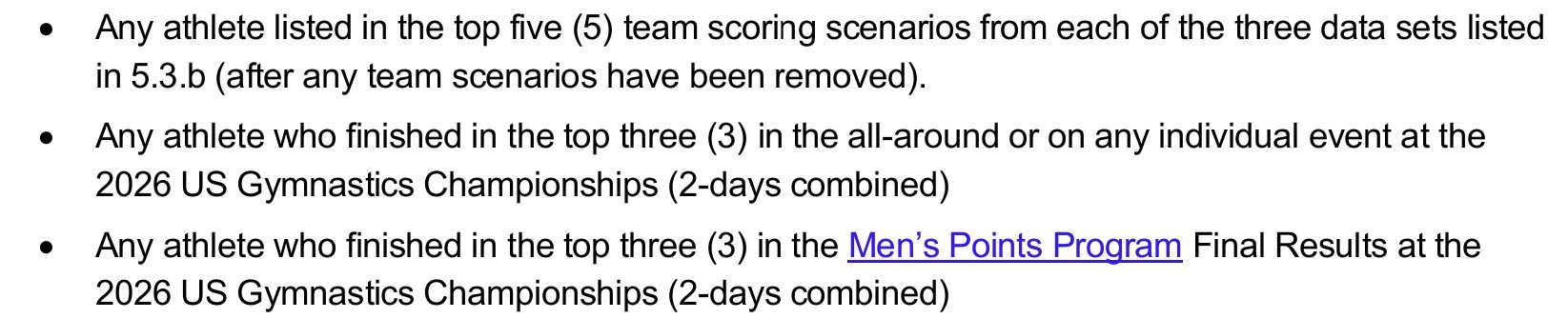
These criteria narrow the pool of athletes who can be selected.
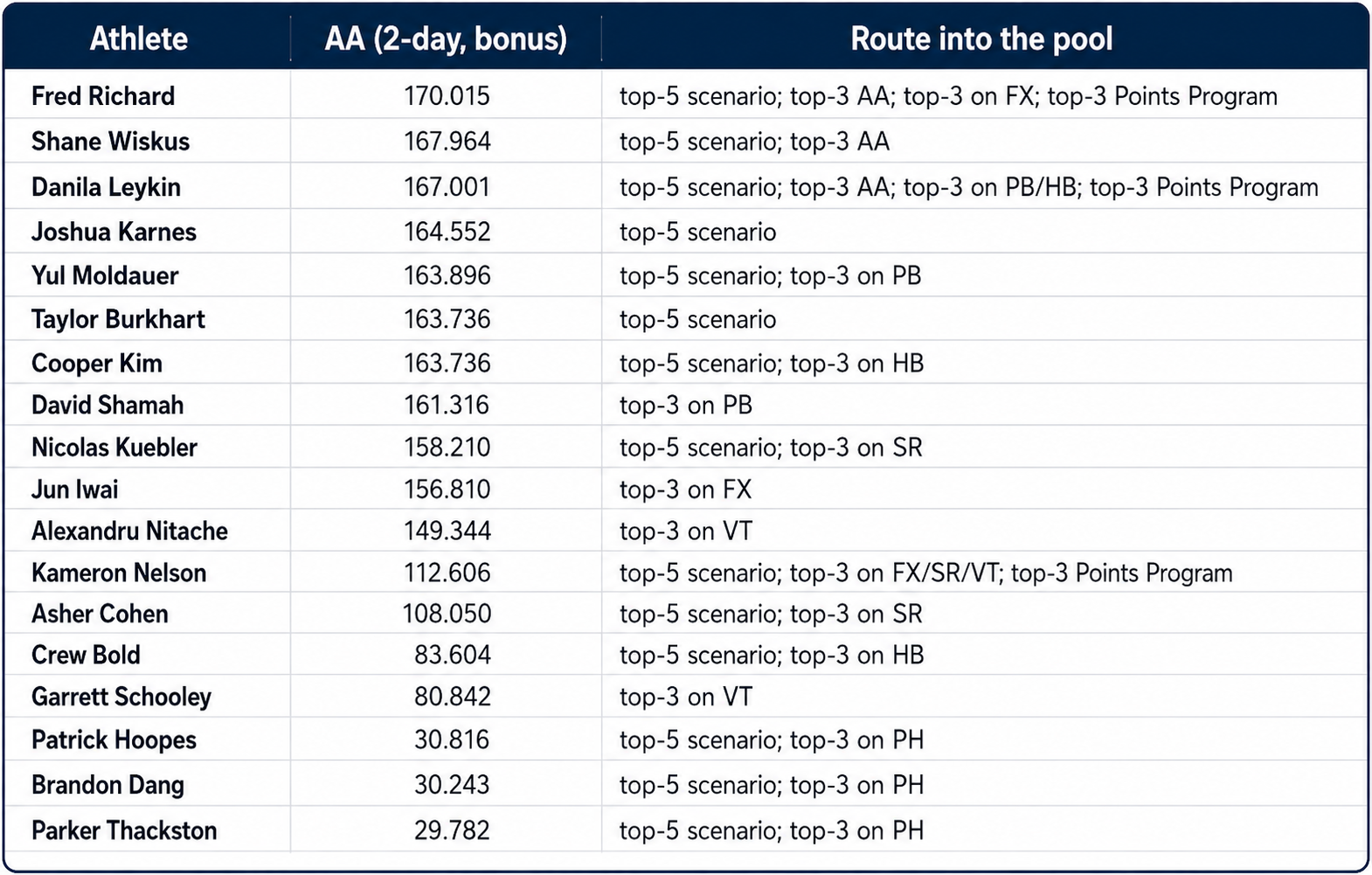
Athlete pool. Top 5 scenario means the athlete appears in at least one of the team calculations above.
Why would USAG select this way rather than just picking the highest-scoring FIG team and calling it a day?
No official has explained the logic, but there is some. The difference between the top FIG team and the fifth one is 0.5 points. For all practical purposes, these are ties. The committee could have decided that if they let math decide a team, it had better be making a compelling case. If not, they would prefer other criteria rather than simply writing down the names of the top 5 FIG teams and drawing one out of a hat. So, they went to the discretionary criteria below.
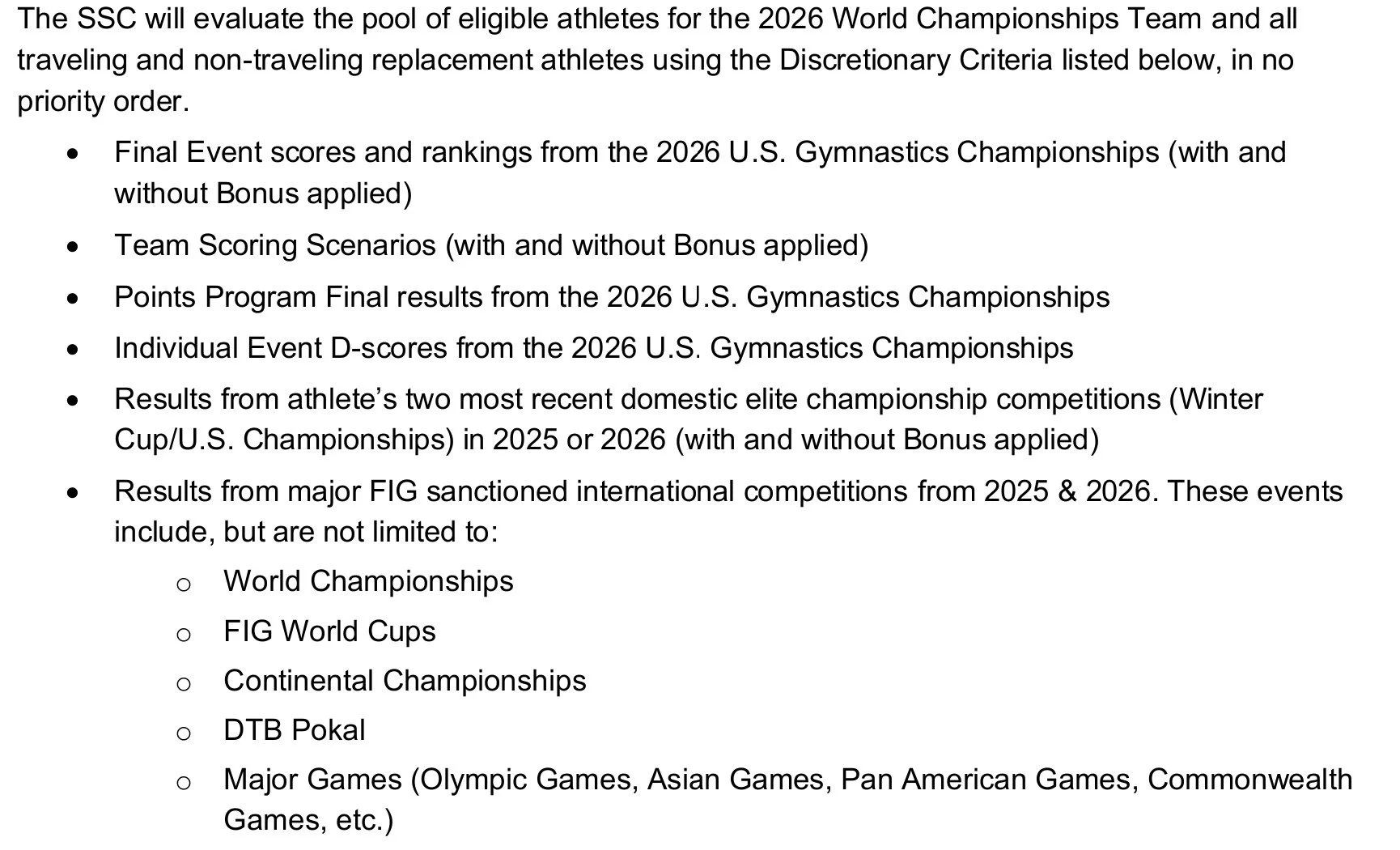
The decision probably came down to Cooper Kim and Patty Hoopes (The top FIG team versus the top bonus team). The top team with a specialist was the top bonus-including team with Hoopes, and that was the one chosen. The US men’s program has emphasized difficulty in an attempt to catch up with the world leaders. Also, if an athlete performs the same D score anywhere on earth, judges should give him the same D score. It’s a known quantity. The E score is another story. Domestic E scores tend to be higher. The tradeoff is a team with a higher total D score against one with optimal FIG scoring.
Other factors that could have swayed the choice to Hoopes are his greater total experience, international success, D score closer to the world-class bar set by the National Team document, and the US having won an Olympic bronze medal while using a pommel horse specialist.
The weakness of the bonus team is that it isn’t as flexible if lineups have to be shifted for some reason. I wonder if this same selection would have been made if it had come after Liverpool 2019, where the lineups that competed likely were not the ones expected when the team was chosen, and the single event pommel specialist did not pay off.
Let’s compare the FIG optimal team to the team chosen using FIG scoring.
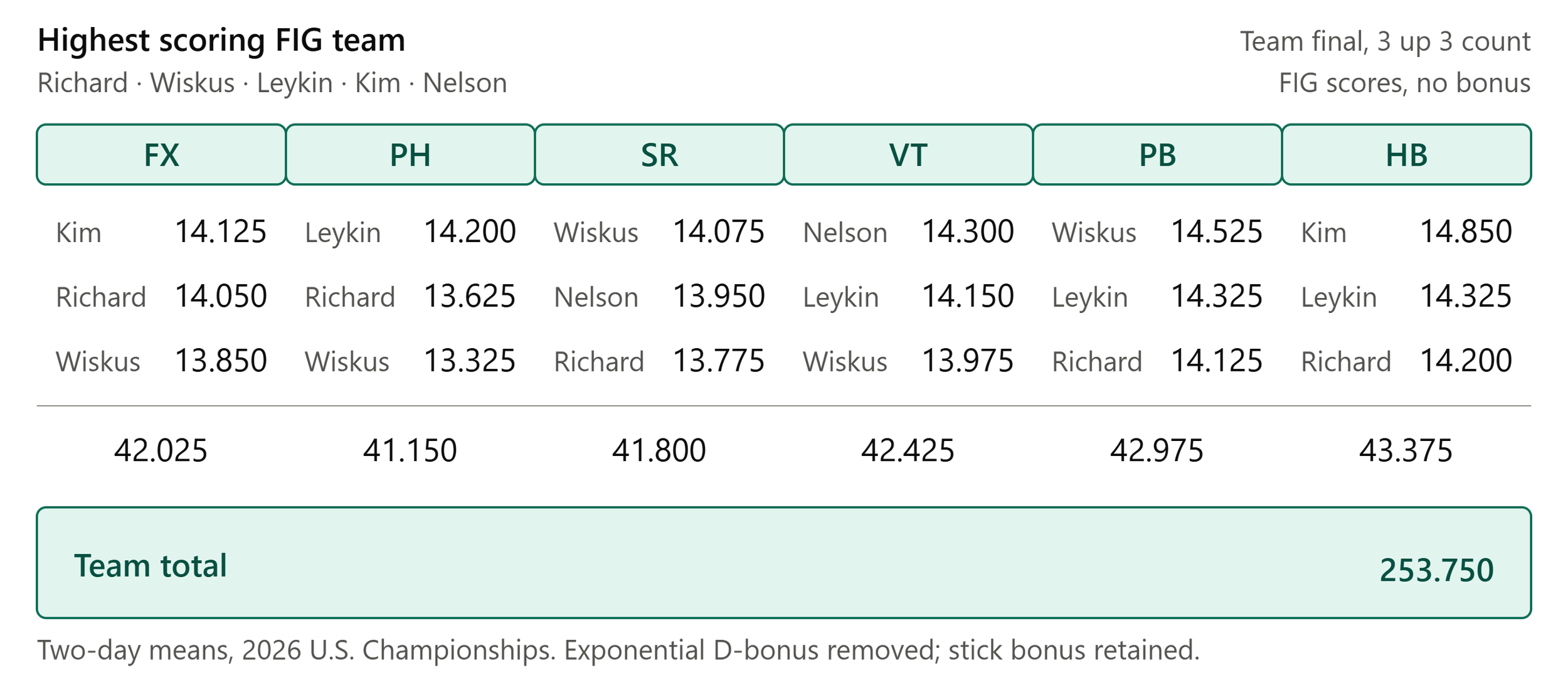
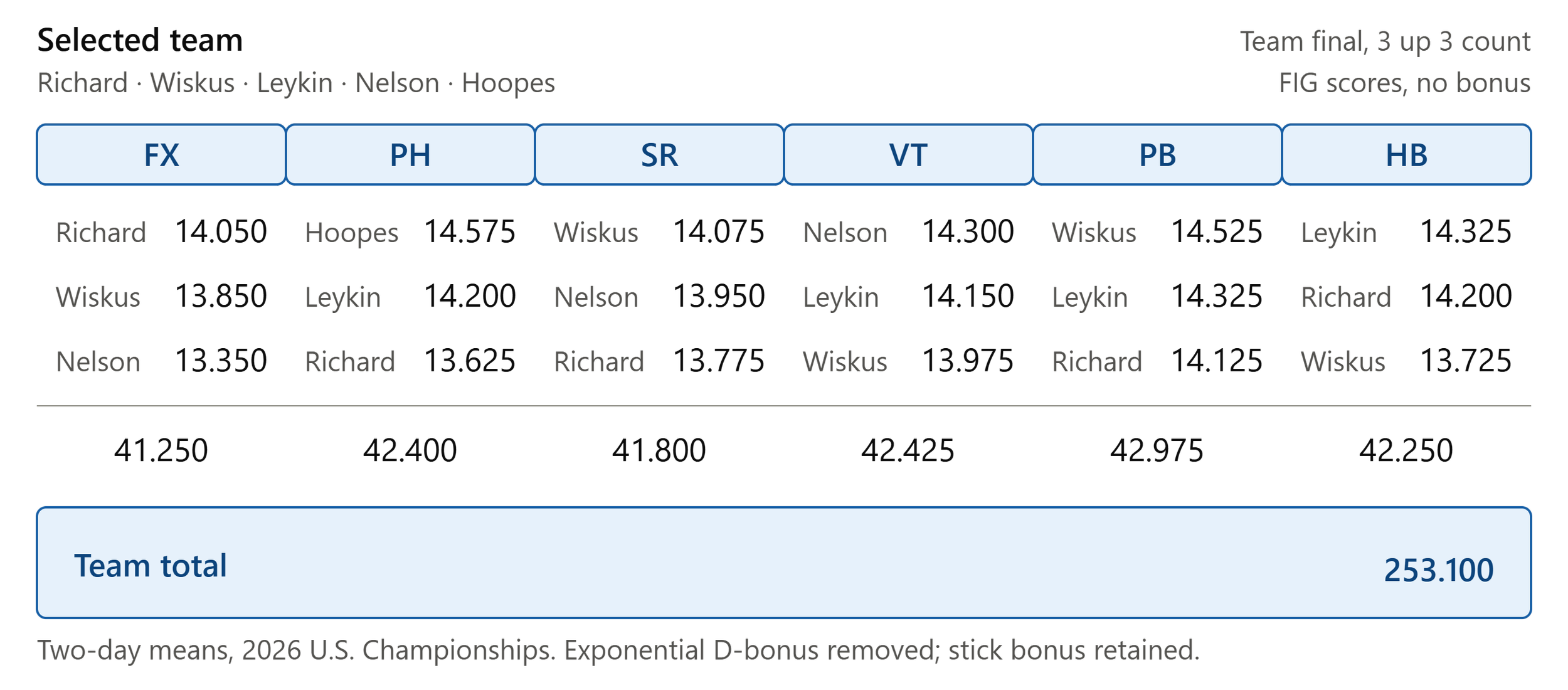
These aren’t that different.
It’s a judgement call. The team they picked is fine. Maybe some people won’t agree with it (personally, I was rooting for Kim), but in real life the choice usually isn’t between the decision you would have made and a different decision obviously made by morons. There are usually grey areas, pros and cons to all sides, and areas of legitimate disagreement which would be resolved differently in good faith by different people.