Men’s 2026 NCAA Championships By the numbers
Regionals Session 1 full replay
Regionals Session 2 full replay
How it went down by the numbers
Rotation 1
D and E scores are for the specified apparatus. They are not running scores. The running scores in this post do not match the PDF, as the PDF scores are not in the real-time meet rotation order.
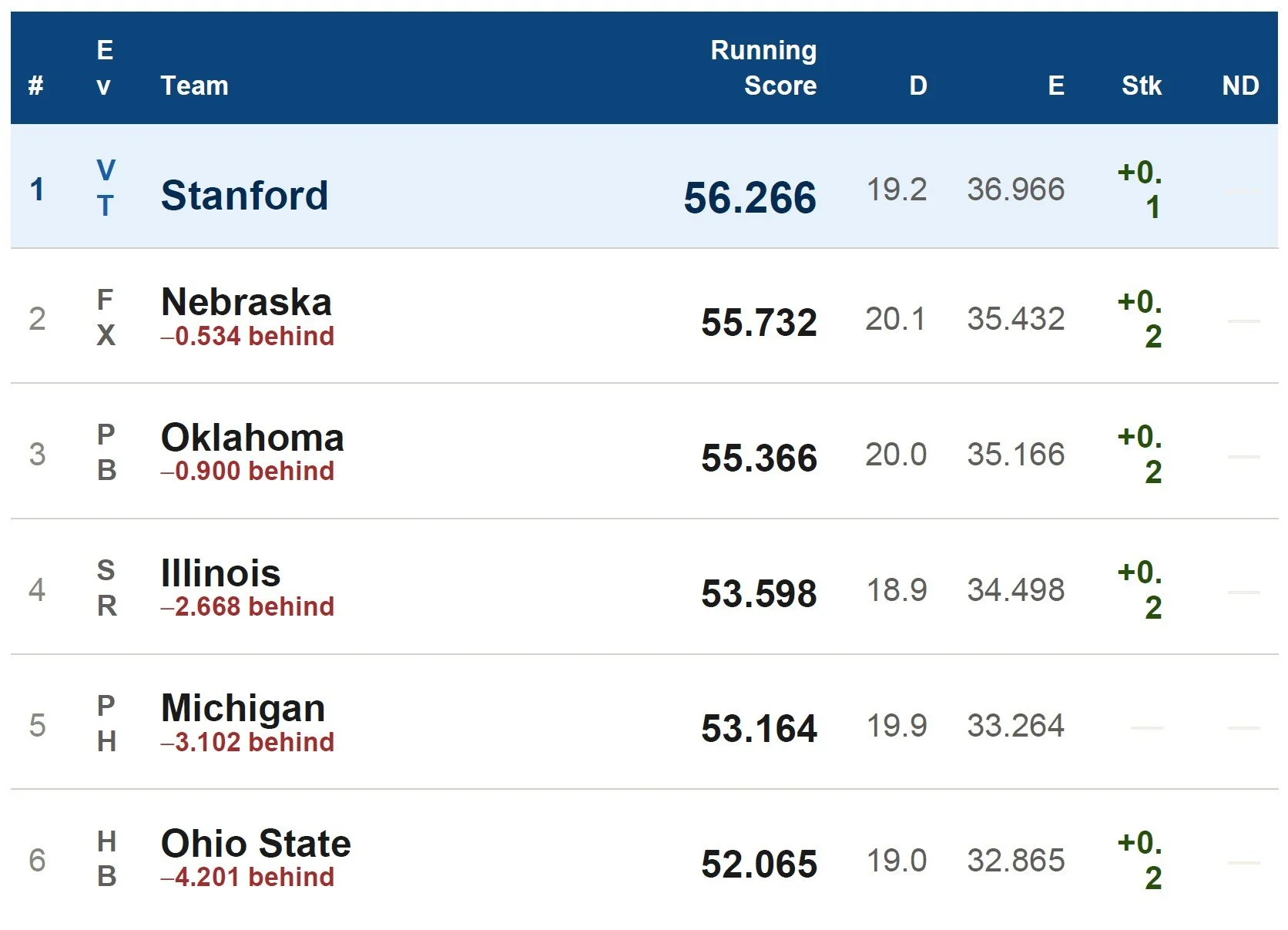
Stanford starts out on vault, its favorite place. Open a big lead early and try not to look back. Nebraska comes out strong on FX, with a season high score anchored by 14+ routines from Luke James (14.033) and Chase Mondi (14.066). Oklahoma on PB, a little trouble early but a strong finish from Tas Hajdu and Nathan Roman with 14.8, the highest PB score of the season, and a team score above their season average. Michigan on PH, also a little trouble early but finishing out with 14.566 from Aaronson Mansberger. Illinois holds its own on SR. Ohio State on HB with a little lower than their season average.
Rotation 2
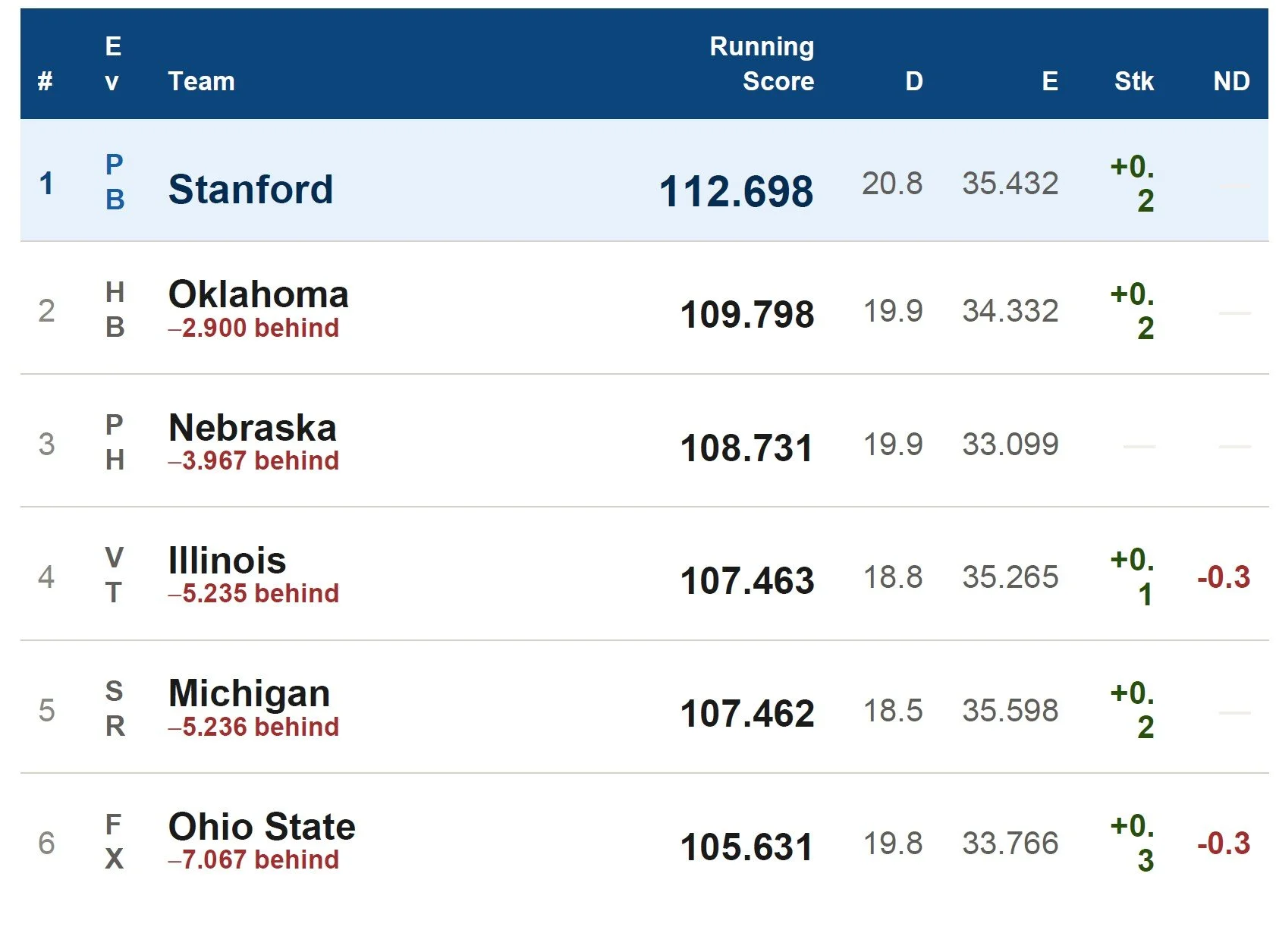
Stanford widens its lead with a massive 56.432 and three 14+ scores on PB. Oklahoma on HB with 54.432, anchored by Kelton Christiansen’s 14.4, highest of the meet. Nebraska on PH with 52.999, not too different than their season average. Illinois goes to vault, which wasn’t perfect (53.865), but gives them enough to pull even with Michigan’s SR (54.298). Illinois and Michigan are now 0.001 points apart. Ohio State on FX with 53.566.
Rotation 3
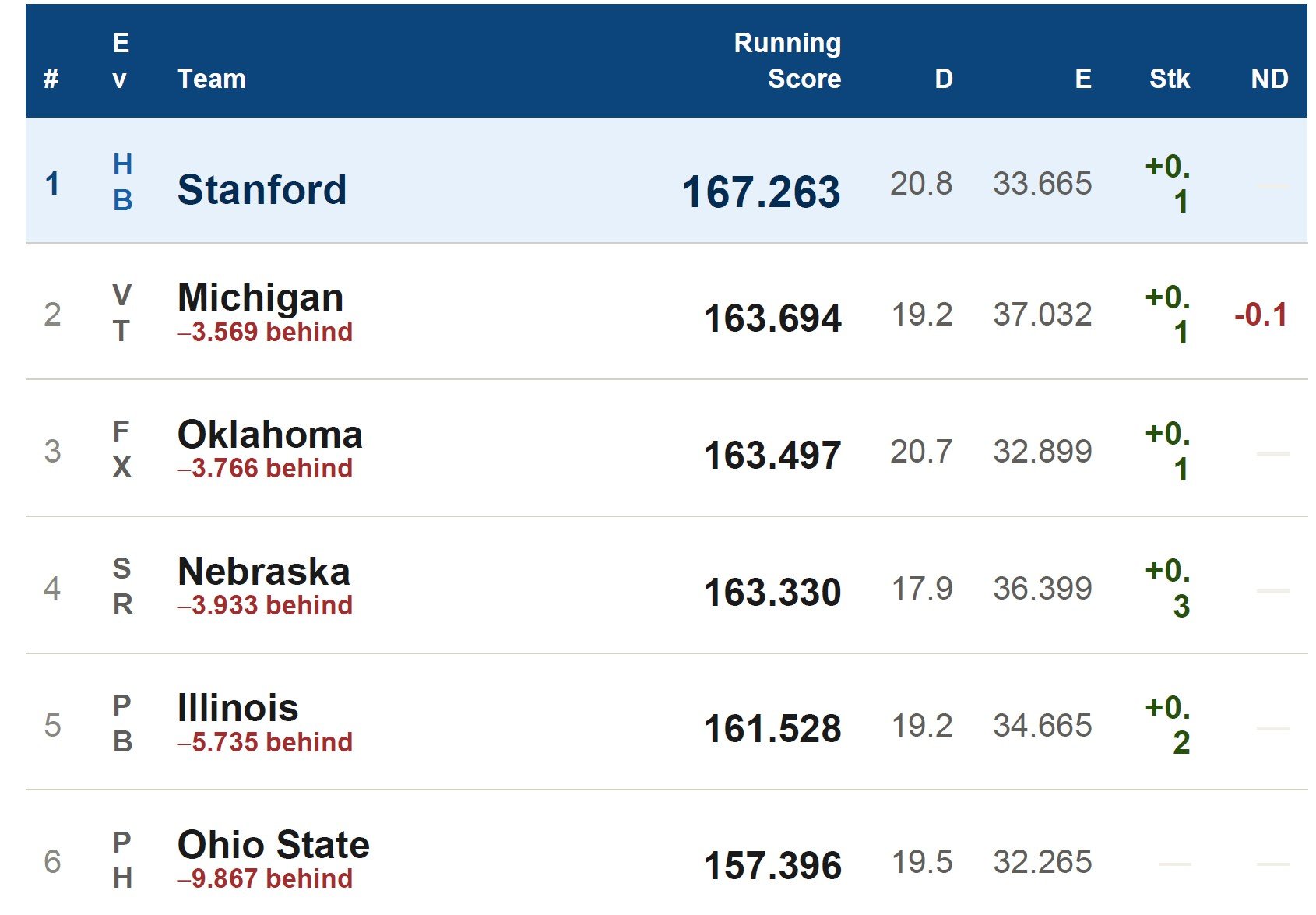
Stanford goes to HB and widens its lead with a close to season high 54.565, highlighted by a 14 from Cooper Kim. Michigan goes to vault (56.232) and pulls ahead of Oklahoma on FX (53.699). Oklahoma didn’t have any really bad scores on floor but was slightly below their season average. Their execution was on the low side of what they normally put up. Nebraska goes to SR (54.599) anchored by event winner Asher Cohen with a 14.5, to pull to within 0.167 points of Oklahoma. Illinois on PB with a season high (54.065). Ohio State on PH with trouble (51.765).
Rotation 4
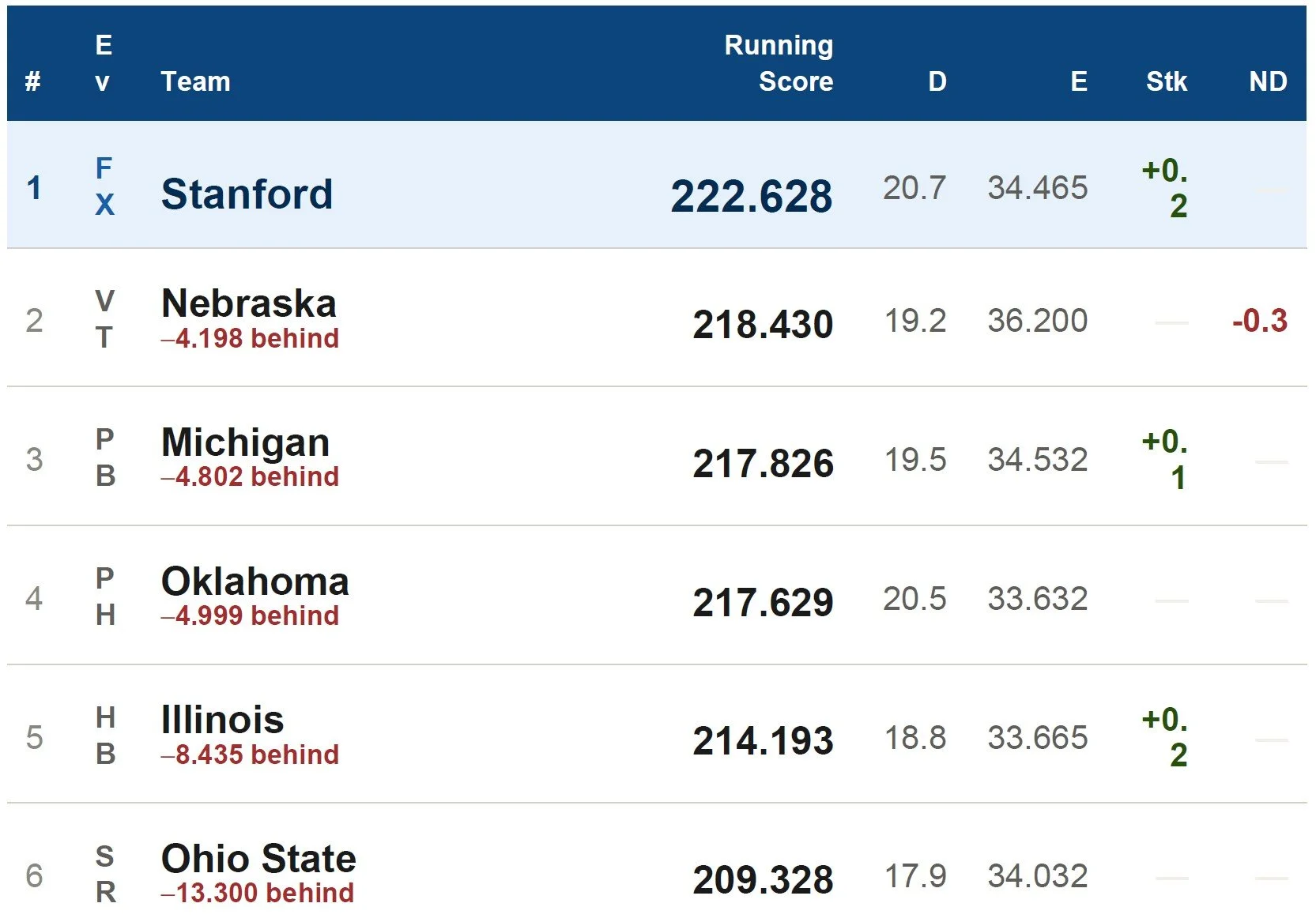
Stanford goes to FX and widens its lead with a 55.365, with 14+ scores from Nick Kuebler and event winner Cooper Kim. Nebraska pulls into second with a 55.1 on vault. Michigan is in third after PB (54.132), anchored by a 14.533 from Olympian Fred Richard. Oklahoma finds itself in fourth after a 54.133, anchored by a 14.133 from Colby Aranda, trailing Michigan by 0.197 points. Illinois on HB (52.665), anchored by a 14 from Sam Phillips. Ohio State with a 52.065 on SR.
Rotation 5
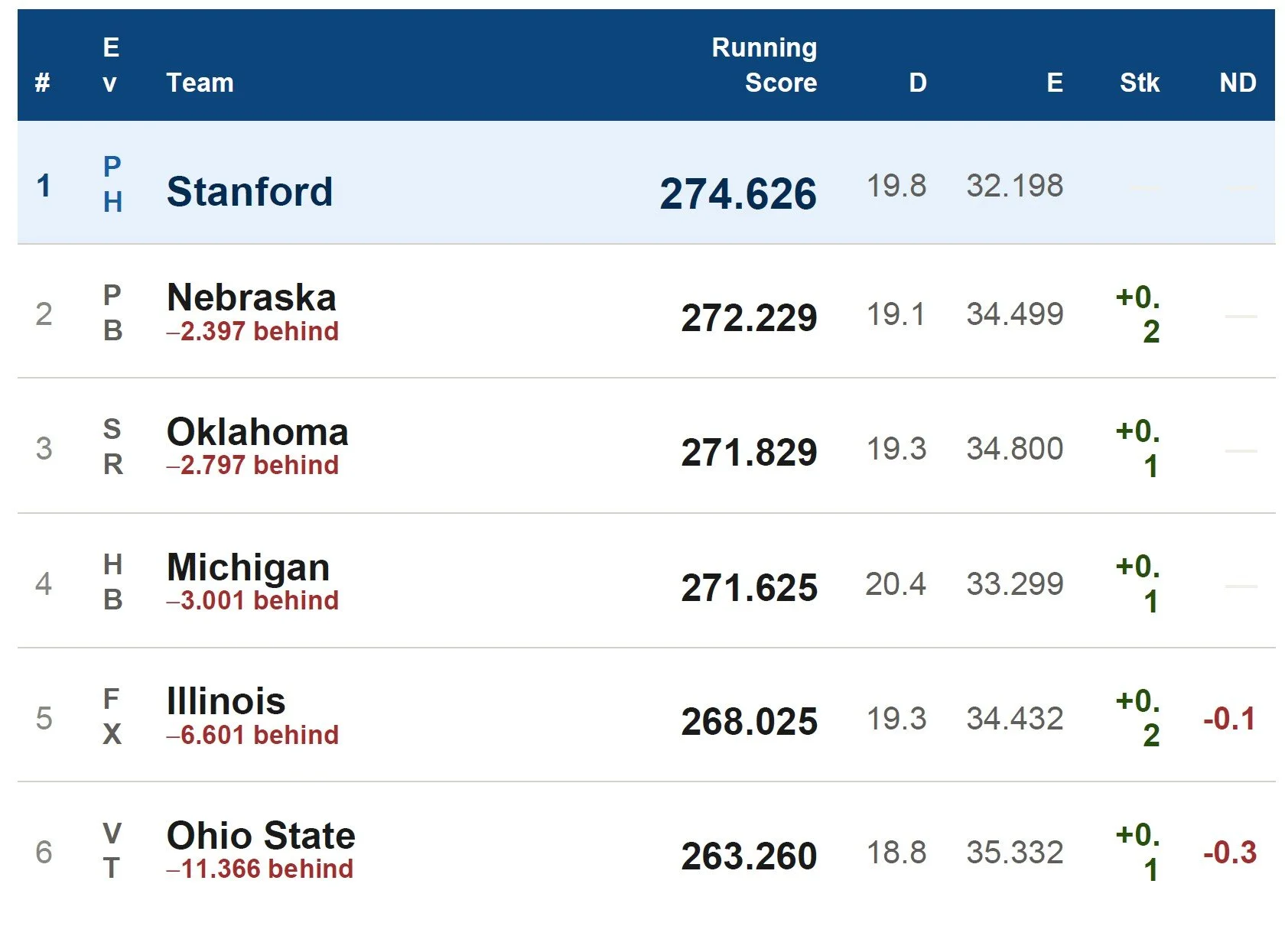
Stanford goes to PH and survives it with a 51.998, competing their lowest team difficulty on that event of the season. Nebraska is in second with a 53.799 on PB and a 14.233 from Nathan York. Oklahoma pulls into third with 54.2 on SR. Michigan in fourth with 53.799 on HB, including a 14.533 from Fred Richard. Illinois fifth with FX 53.832 and a14.166 from Tate Costa. Ohio State sixth with 53.932 on VT. At this point, 0.604 points separates second from fourth.
Rotation 6
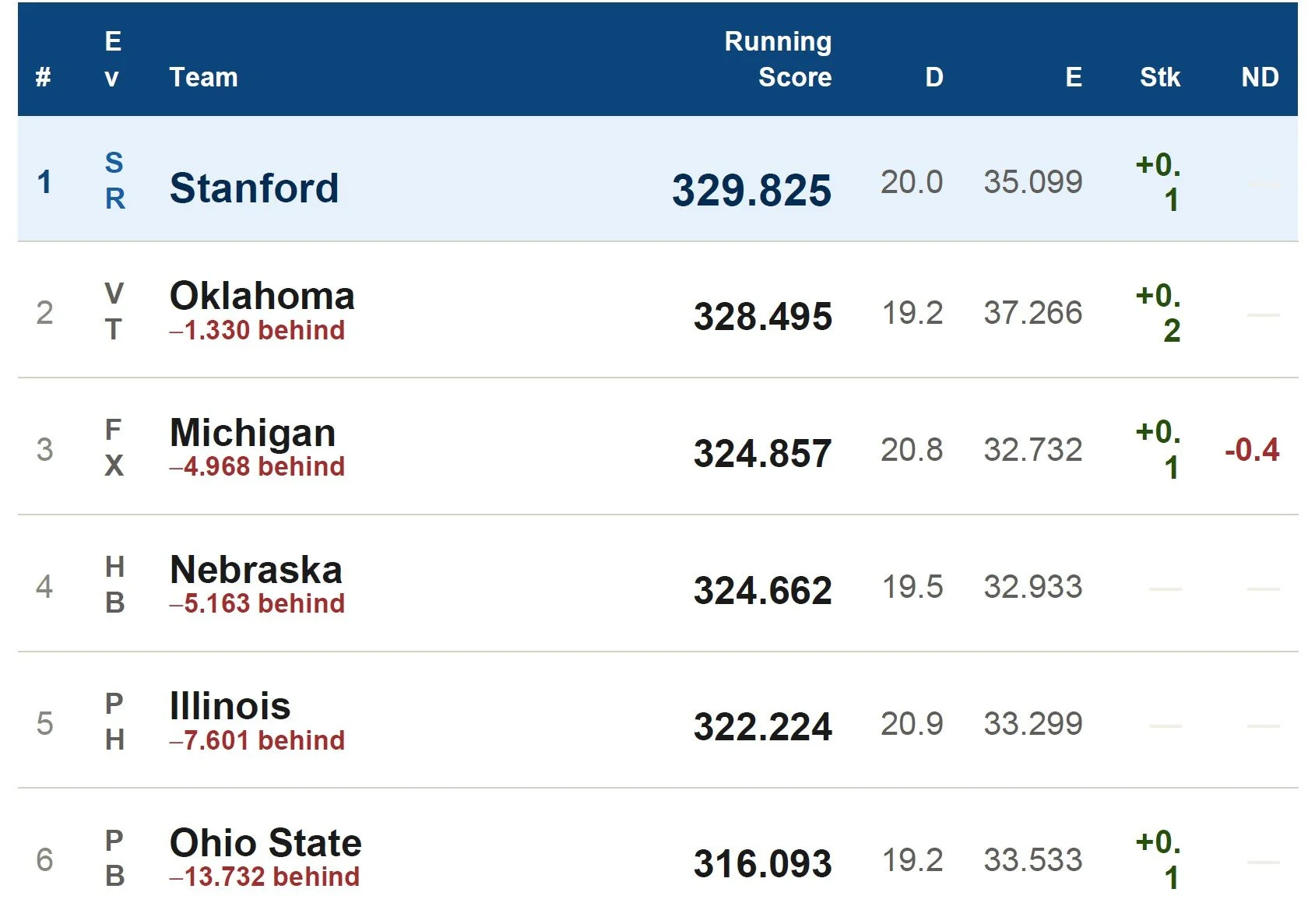
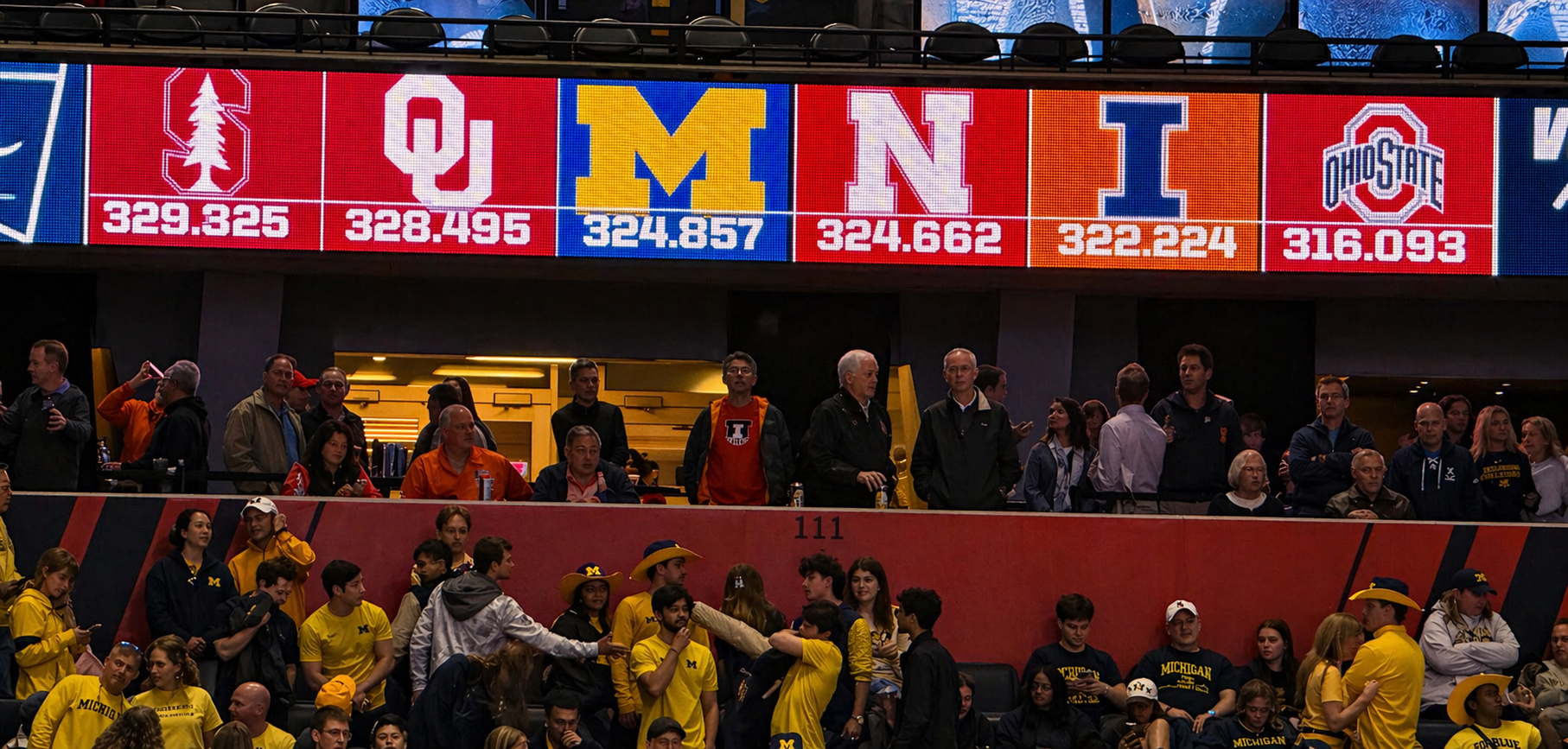
Stanford crosses the finish line after leading wire to wire with a 55.199 on SR, anchored by a 14.166 from Nick Kuebler and a 14.3 from Asher Hong. Oklahoma cuts Stanford’s lead down to 1.33 points with a 56.666 on vault, anchored by a 14.333 from Tyler Flores (who shared the vault title with Stanford’s Jun Iwai). Oklahoma had the highest execution score of the entire meet on their last event. Michigan finished out on FX with a 53.232 and a 14.4 from Fred Richard. Nebraska finished fourth in almost a dead heat with Michigan, with a 52.433 on HB. Illinois closes out on PH in fifth with a 54.199 and a 14.7 from event winner Brandon Dang. Ohio State finishes up on PB with a 51.932.
The Final Analysis
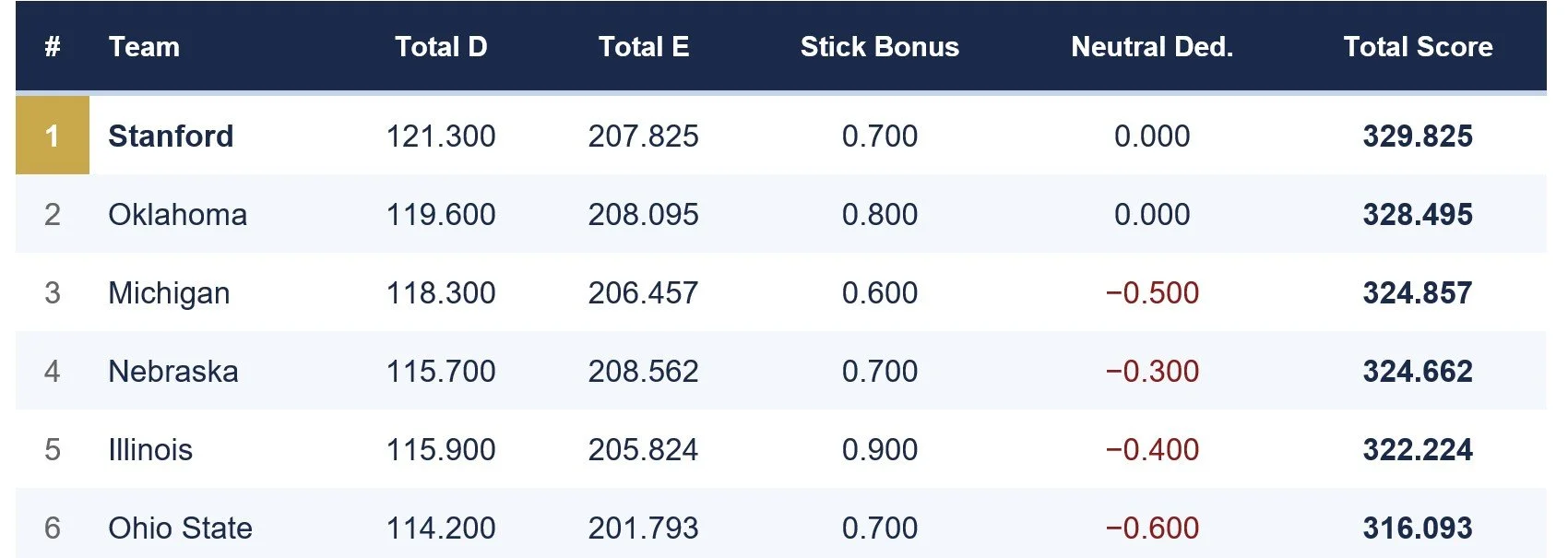
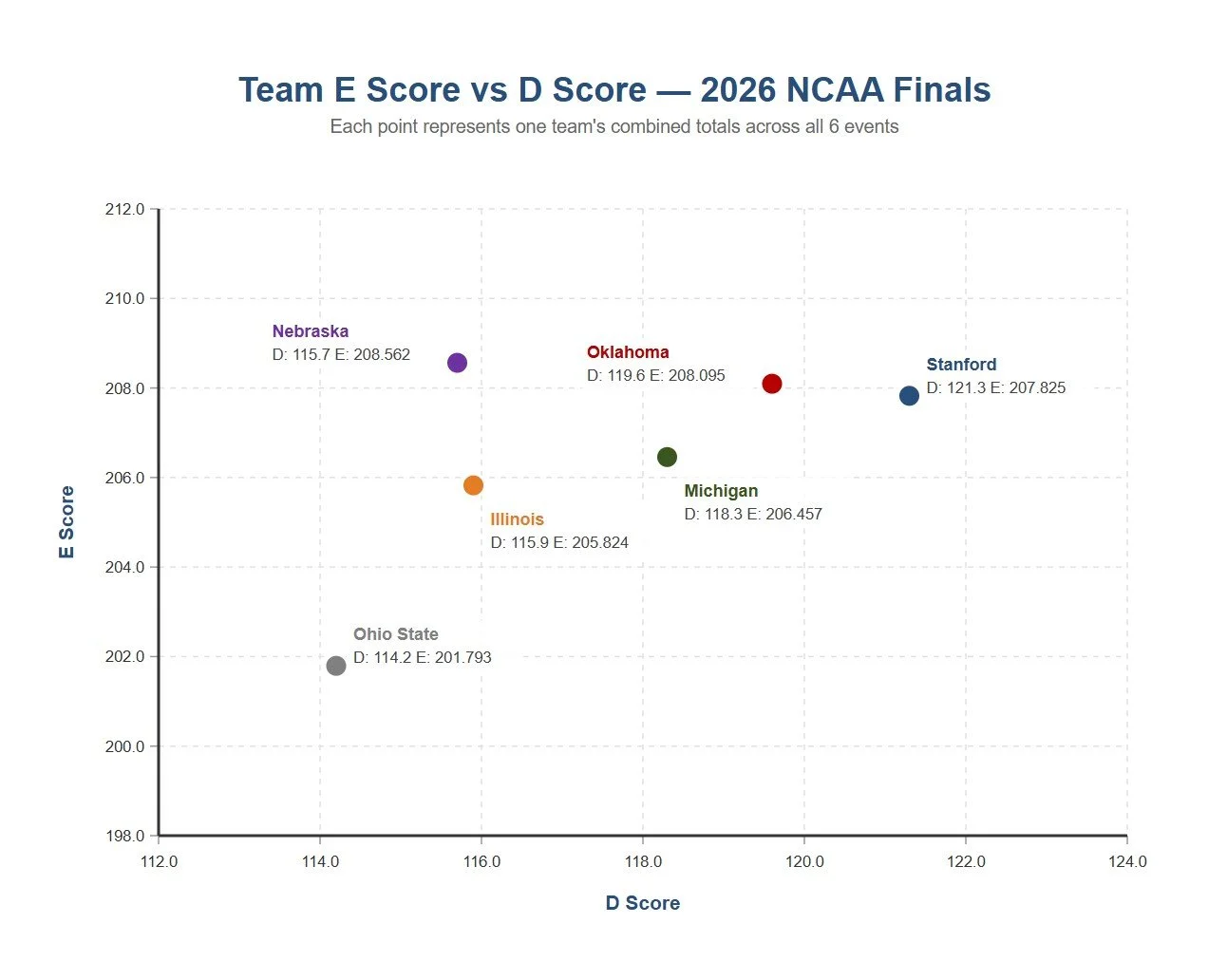
This one isn’t very complicated. Stanford won because it had the most difficulty and hit all their routines. The pattern over the season is typical for Stanford. They have often been ranked two or three only to come on strong at NCAAs and win. Unlike some other years, Stanford wasn’t so far ahead of the others in difficulty they would be next to impossible to beat. They had 1.7 points of difficulty on Oklahoma, which is not insurmountable. It just wasn’t Oklahoma’s day, with Stanford having a team execution season high by over 2 points. Stanford performed at the high end of its normal range. There is some luck involved in gymnastics, mostly from judging variance and random execution errors.
Third (Michigan) and fourth (Nebraska) were separated by 0.195 points. Michigan had 2.6 points of difficulty on Nebraska, but Nebraska was able to come so close because it had the best execution of the meet. In this meet, teams with higher difficulty tended to have better execution. Nebraska is the outlier with the second lowest difficulty but the best execution.
Illinois managed to score a season high after a rough season. They outperformed their season average by over 9 points.
The results of both this competition and the 2025 NCAA Championship are what the officials called on the field of play on that day.
I’ll have more to say on this. Stay tuned.
Let me know if I made any mistakes!