Who will Win the 2026 Men’s NCAA Gymnastics Championships?

By Dall E. The pommel guy in the background is getting some major deductions.
In which I use a method used in the development of the H bomb (Monte Carlo Simulations) to figure out what everyone already knows - the race is between Oklahoma, Stanford, Michigan, and, possibly, spoiler Nebraska.
The top 3 are fairly close in potential, so luck will likely have a large role in the result.
Out of Stanford, Oklahoma, and Michigan, whichever makes the fewest errors will probably win.
Stanford has the most difficulty, but the margin is not as great as last year (especially on vault, where they had a monster 20.3 total difficulty. Michigan is close to the same level as last year. Oklahoma has put a little more distance between itself and the rest of the field - so they are in less danger of finishing fourth if they have a bad day.
No team in this meet has enough difficulty they can fall 5 times and still win.
I used the data from the entire season and used the conference championship scores for 50 % of the simulations, as these lineups tend to be more reflective than regular season meets of championship lineups. Home meets were given very slightly less weight.
The computer models look at scores. It does not account for coaches’ decisions to rest people, gymnasts not in the lineup because they were competing internationally, injuries, or judging errors/bias. It compares scores from different meets, which is tricky.
Inside Gymnastics Preview with how-to-watch and coach interviews. Coaches are mostly saying they have to hit, which is true, as no one team has enough difficulty to absorb multiple errors and still win if their rivals hit.
Inside Gymnastics is picking Oklahoma. So are these computers. The computer models love Oklahoma, because unlike Stanford or Michigan, Oklahoma tends to use its strongest lineups during the regular season.
Last but not least, there are clear leaders here, but each team and individual gymnast is valuable to the group. There are individuals to watch on all the teams competing.
Without those Simpsons and William & Marys, the stars would likely not be playing at all.
Take all probabilities with a large grain of salt, because the model compares scores from different meets. Rank order is more reliable.
Session 1
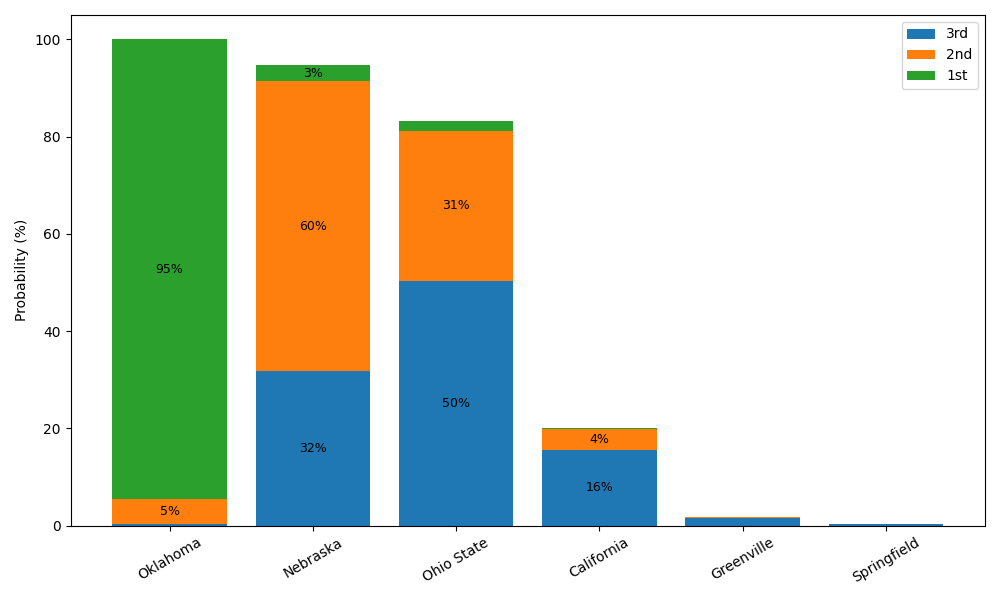
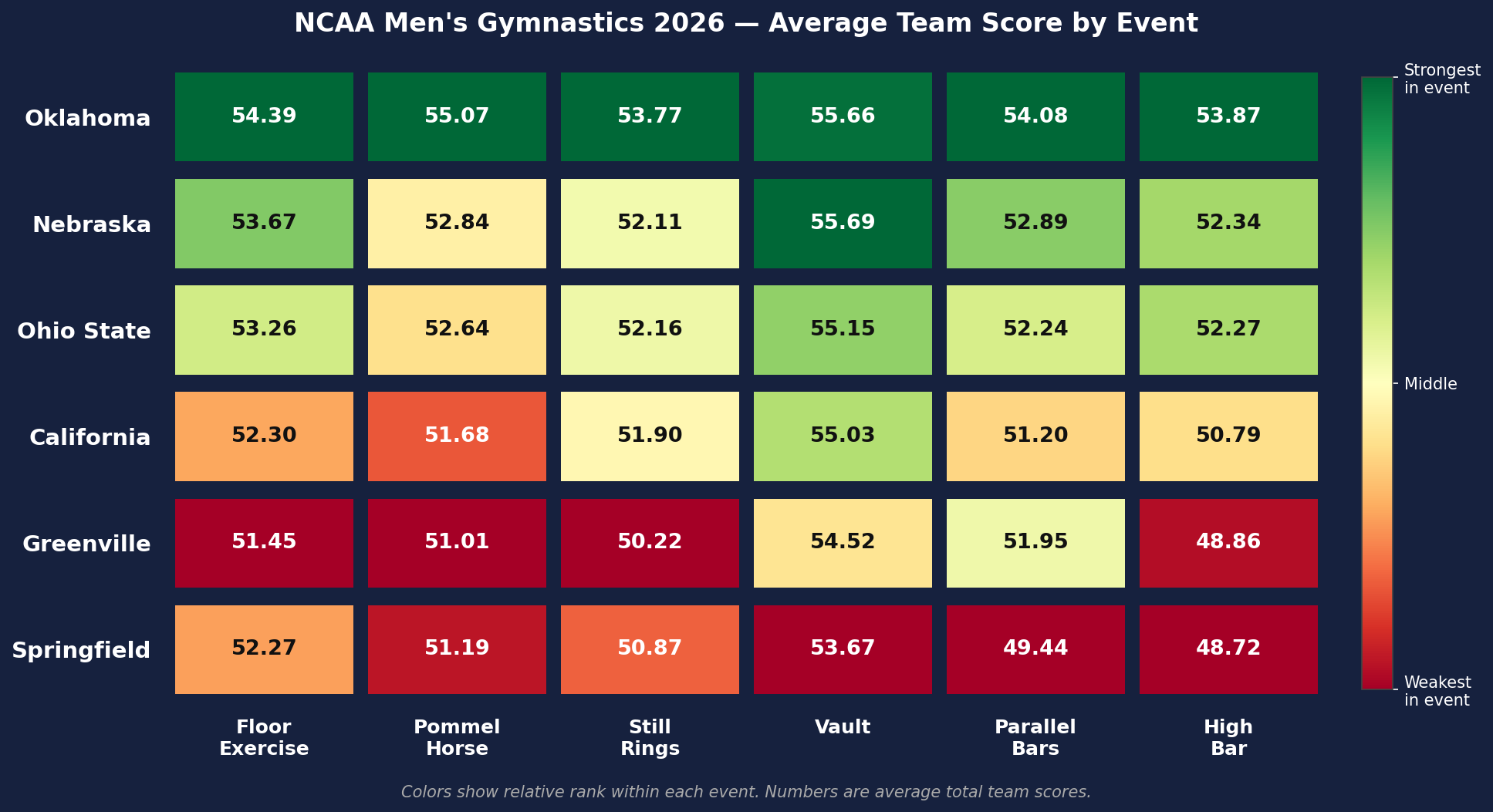
Average of all scores of the season.
If there is one sure thing in this meet, it is that Oklahoma is making the final. Nebraska is pretty close to a sure thing. I would not expect either Oklahoma or Nebraska to put up their strongest lineups in prelims. Ohio State looks to get through, although California would love to be the spoiler, as it almost was last year.
Session 2
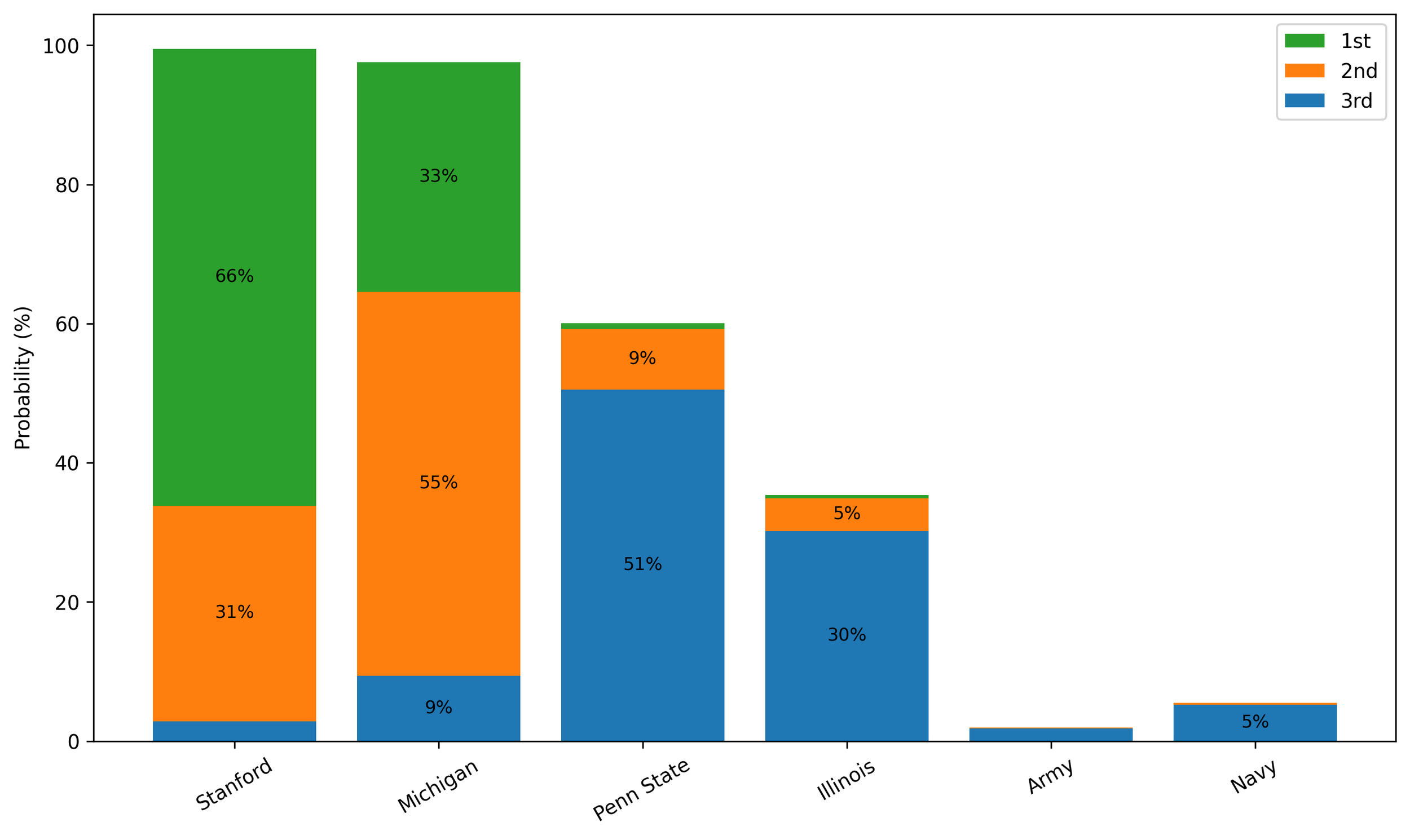
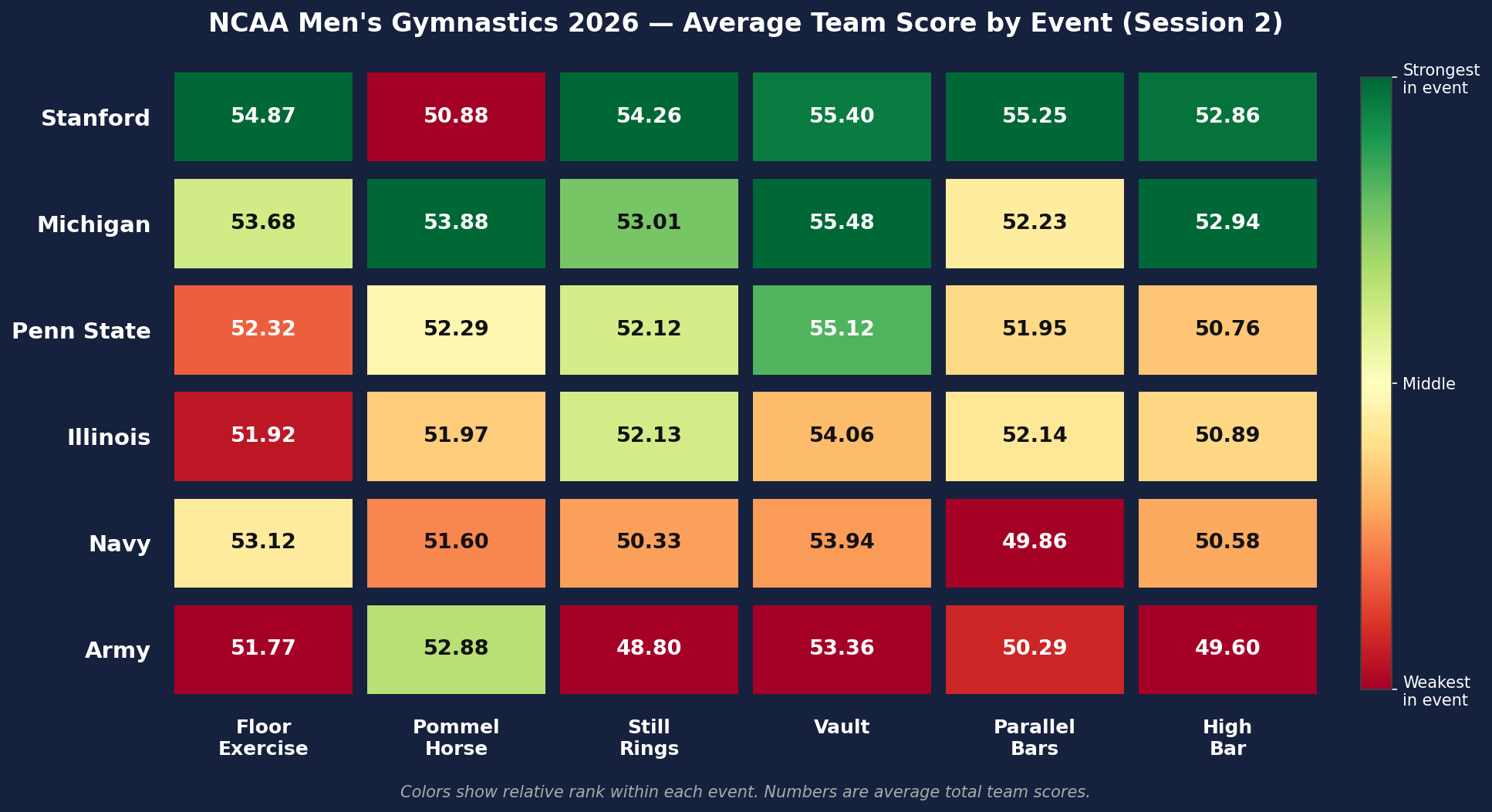
Stanford and Michigan are almost guaranteed to make it to the final. Where it gets interesting is the race between Penn State and Illinois. Illinois has the difficulty, they just haven’t been able to put it all together because of injuries and bad luck. The computer has Penn State ahead, but the last time these two met, Illinois finished ahead. Illinois may have been conserving in anticipation of being at home for the championships. I would put these two closer together than the model does.
The heat map also highlights what has been a trouble spot for Stanford all season, because of consistency. Their difficulty is competitive with Oklahoma on that event.
The Final Guess
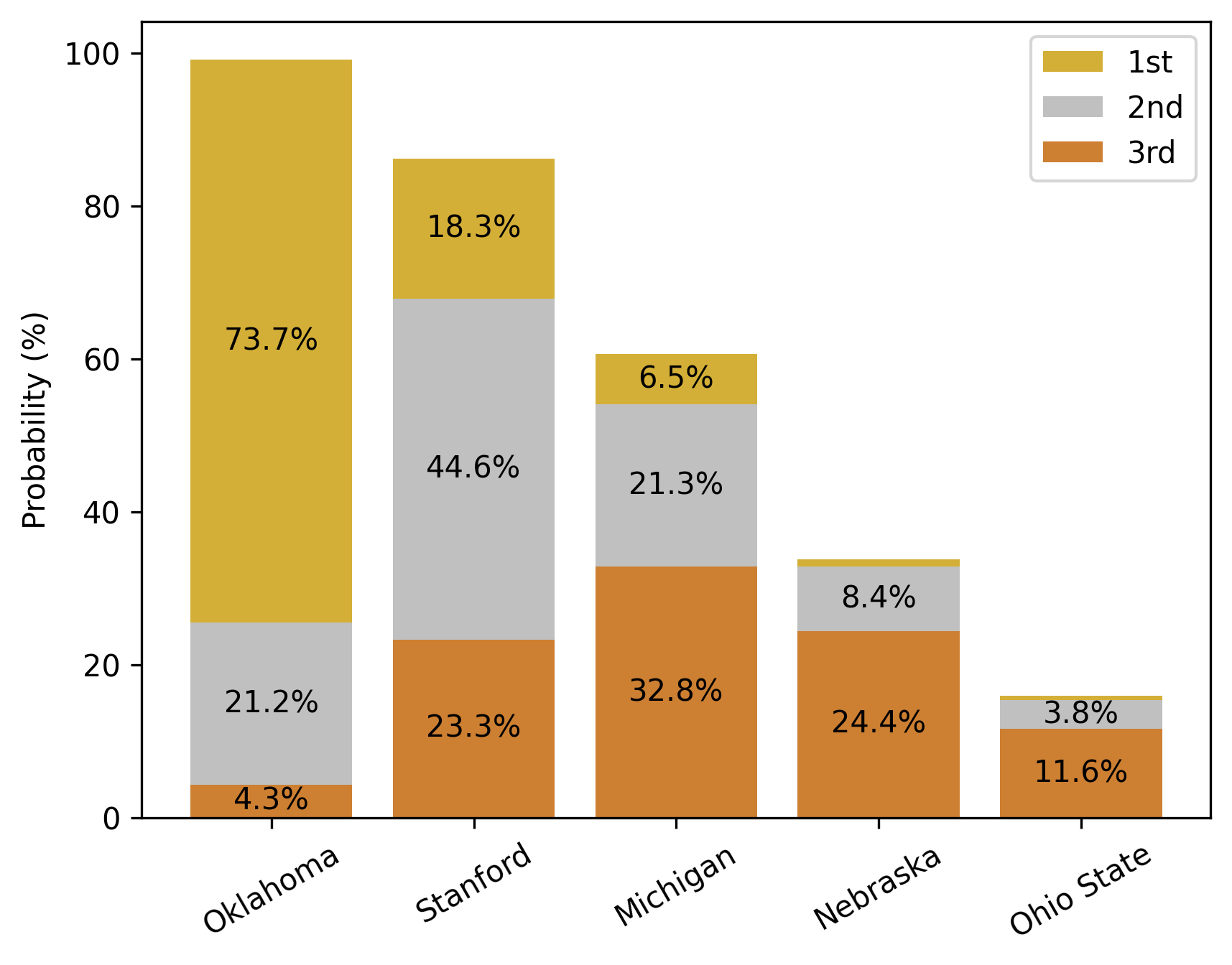
The computer models really love Oklahoma. I would say it is undervaluing Michigan because Big 10s was heavily weighted in the model, and Michigan scored lower than Oklahoma and Stanford did at MPSF. It’s also not giving Illinois any chance, which I also don’t agree with. If Illinois puts it all together, they could surprise. On paper, as far as difficulty goes, Illinois doesn’t look all that different from Nebraska.
The Bottom Line
Stanford has the difficulty. If they hit everything, they win. If everyone hits (based on the difficulty competed this season), it will be Stanford, Michigan, and Oklahoma. The top three are pretty close
Michigan is probably a little bit ahead of Oklahoma in difficulty, but they cannot afford many mistakes if they want to win.
Don’t forget about Nebraska.
A word about the judges
Most of them probably are doing their jobs. If they were not, these models wouldn’t be able to make predictions that make much sense. When fed the numbers generated by judges, the simulation comes up with something that looks like what most people expect.
I’m sure some of them are bad. There are people in every profession who probably should not be there.
For example, this doctor who removed a spleen because he thought it was a liver. He’d messed up before, claiming someone’s adrenal gland somehow migrated to the pancreas.
The average doctor is not like this. Most of them are average. Some of them are great, and some of them are terrible. The trick is to get rid of the terrible before it can do too much damage.