Test Driving the USAG MAG World 2026 World Selection Criteria on Japan
AI slop by Nano Banana
I took the USAG 2026 MAG World selection criteria for a spin on results from Japan’s NHK Trophy. The driver was my robot friend Claude Opus 4.8. Let’s see who the machine picked! We also get a preview of what kind of numbers the Japanese may produce in Rotterdam.
Get used to the machines. The day is coming when some federation uses AI to choose a team. There is no escape. You have to watch these machines, though, because they can and do make mistakes.
Information used
2026 Artistic and Rhythmic Gymnastics Score Tracker - Google Sheets
2025 Artistic and Rhythmic Gymnastics Score Tracker - Google Sheets
USAG 2026 World Championship Selection Procedures
Results were machine-translated and matched against the MAG names database in the 2026 score tracker. They do not match exactly the Seiko English translation on the JGA website, as some of those were romanized differently. I don’t believe this affected the analysis.
Japanese internal AA bonus was not included.
The machine did all calculations, and it made all the figures. The “I” in the figures is the machine. Any math mistakes are its fault. I tried to weed out the obviously wrong stuff. This is probably partly how the US Men’s program will do this - input a bunch of numbers and have a computer do the initial calculations.
**** Reminder - this discussion is NOT in any way related to the actual Japanese selection process. It is the USAG process tested on Japanese results ****
I believe the official Japanese selection process includes 4 days of competition spread over two meets. The team top 3 AA, a 4th who is from the top 10 AA, and a fifth who maximizes the total team score. I’m sure someone will let me know if I’m wrong. It’s more straightforward than the US process. For fun I might try using this on US scores just to see what happens.
Starting with section 5.3a of the USA procedures, step 1 is to determine anyone automatically selected by winning the AA (bonus included) and finishing top 3 on 3 events.
Oka Shinnosuke meets the criteria, so all projected teams must include him.
5.3b is the team calculations under 5-3-3 and 5-4-3 scenarios as below.
• Set 1 will include team scoring scenarios with the Men’s Exponential D-score Bonus applied.
• Set 2 will include team scoring scenarios without the Men’s Exponential D-score Bonus applied (FIG scores)
• Set 3 will include team scoring scenarios using individual event Difficulty (D-scores) only.
If a team can only field three on any event in qualifications (because two of its five are single‑event specialists who skip that apparatus), it won't be named.
If the top-scoring team scenario from each of the data sets listed above consists of the same athletes, then that team will be named.
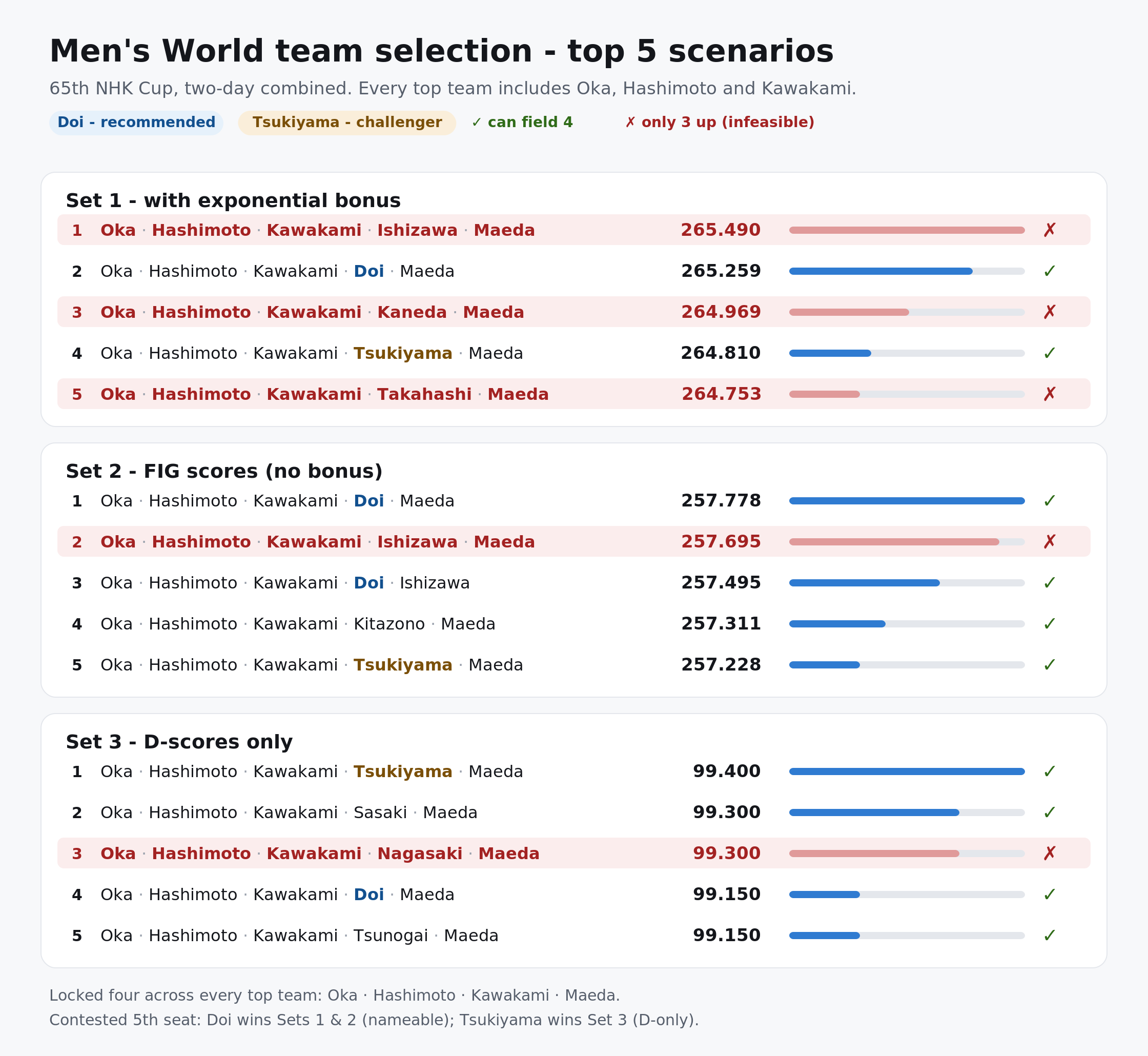
This is a simulation of the US Men’s World Team selection procedure using data from the NHK Trophy. It is not anything official.
Things to notice include that the bonus score teams generate more unviable teams, and the difference between the top and bottom straight FIG and D score teams are tiny. The teams on top of those two lists are separated by tiny margins, which in the straight FIG sets is partly due to chance.
The bonus really inflates the team scores.
There is no separate 5-4-3 data set listed, as 5‑4‑3 drops the lowest of four, so the counting three are the same as 5‑3‑3.
As the top three teams from each scenario were not identical (which was always unlikely due to chance alone), discretionary selection comes into play. It is applied to the pool of athletes defined by the following criteria.
• Any athlete listed in the top five (5) team scoring scenarios from each of the three data sets listed in 5.3.b (after any team scenarios have been removed)
• Any athlete who finished in the top three (3) in the all-around or on any individual event at the 2026 US Gymnastics Championships (2-days combined)
• Any athlete who finished in the top three (3) in the Men’s Points Program Final Results at the 2026 US Gymnastics Championships (2-days combined)
In this case, the pool was narrowed to 17 athletes.
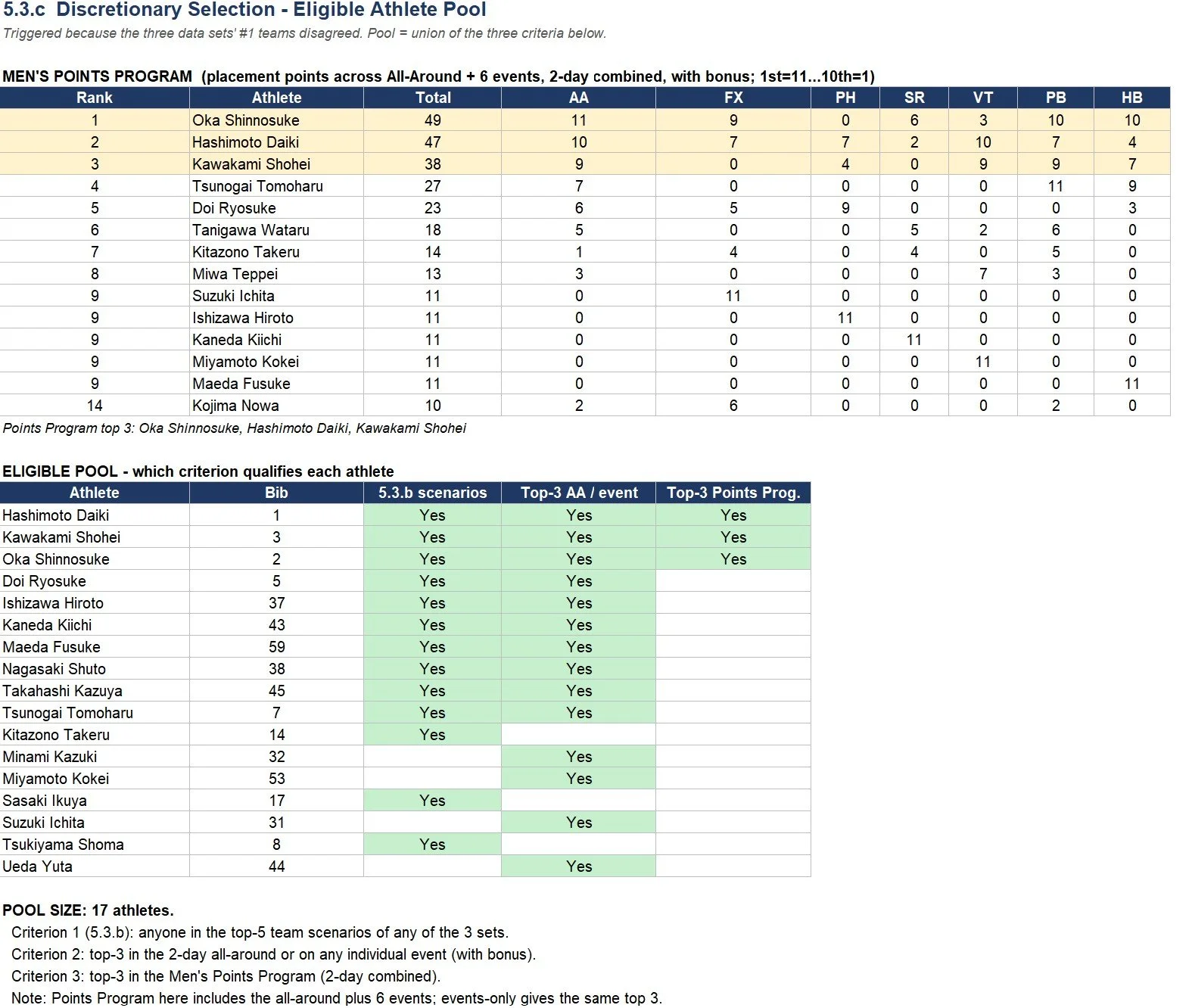
This is a simulation of the US Men’s World Team selection procedure using data from the NHK Trophy. It is not anything official.
And 5.3c, which is found in the linked USAG document, and looks at D and E scores, international and national results, and team scoring scenarios.
Claude pondered this and chose Oka, Hashimoto, Kawakami, Doi, and Maeda, which is the same team Japan actually chose. It also happens to be the highest scoring team with straight FIG scoring.
Claude explains its reasoning below. It was mostly a choice between Doi and Tsukiyama, and it had a tough time with it. It was basically a toss-up.
I let the robot handle all of this. Many people seem to believe the best selection is one that resembles one generated by a machine, so here it is.
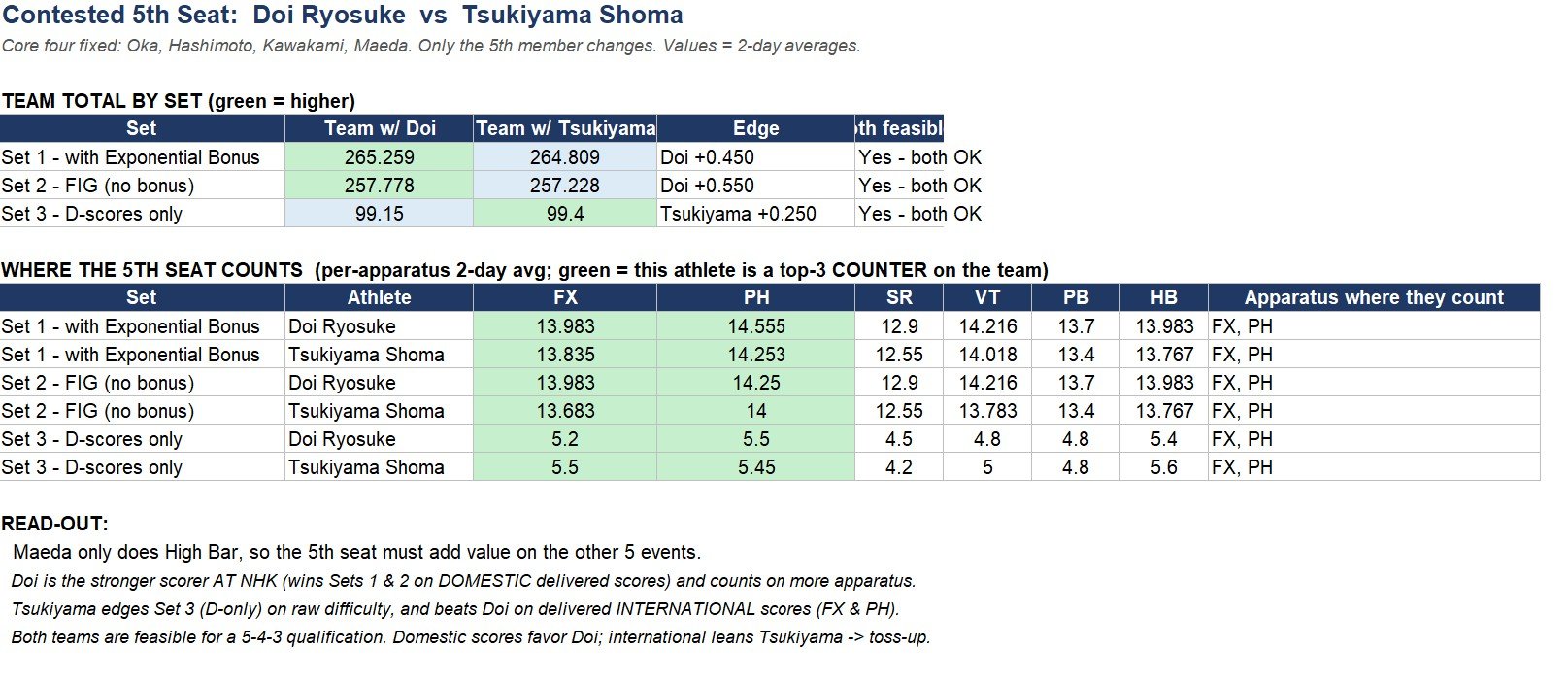
Why are there D scores like 5.45? Because it is a two day average.
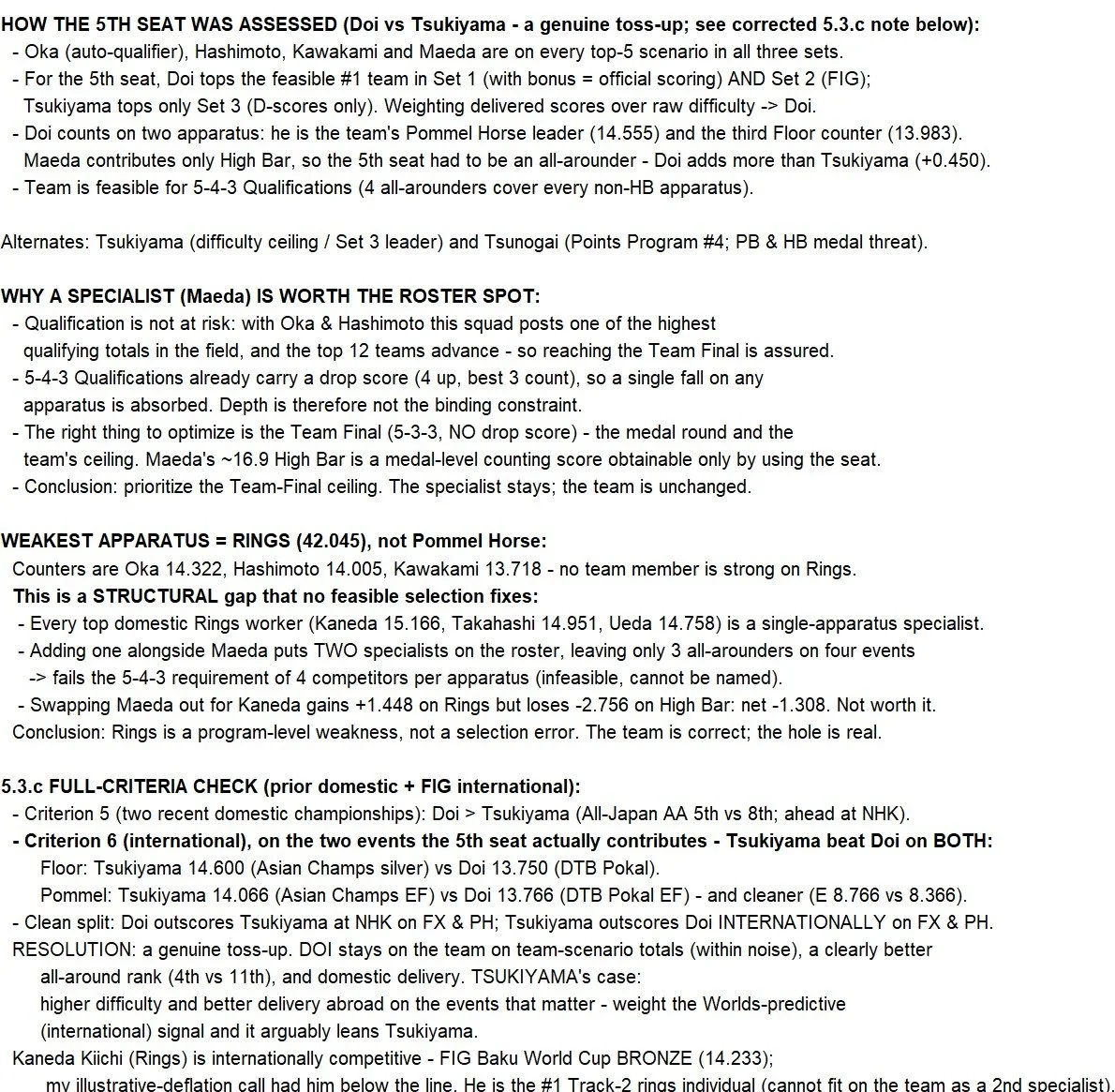
The robot was able to avoid two mistakes I’ve seen humans make. It did not become obsessed with still rings because it’s a weak spot for the team. This could be an issue for the US with the withdrawal of Asher Hong and Donnell Whittenburg. It also didn’t just pick people based on D scores, because total score is what matters.
The USA procedure ended up picking the same team the Japanese system did, despite in reality using 4 competitions instead of 2 and a much simpler selection process (mostly based on AA results).
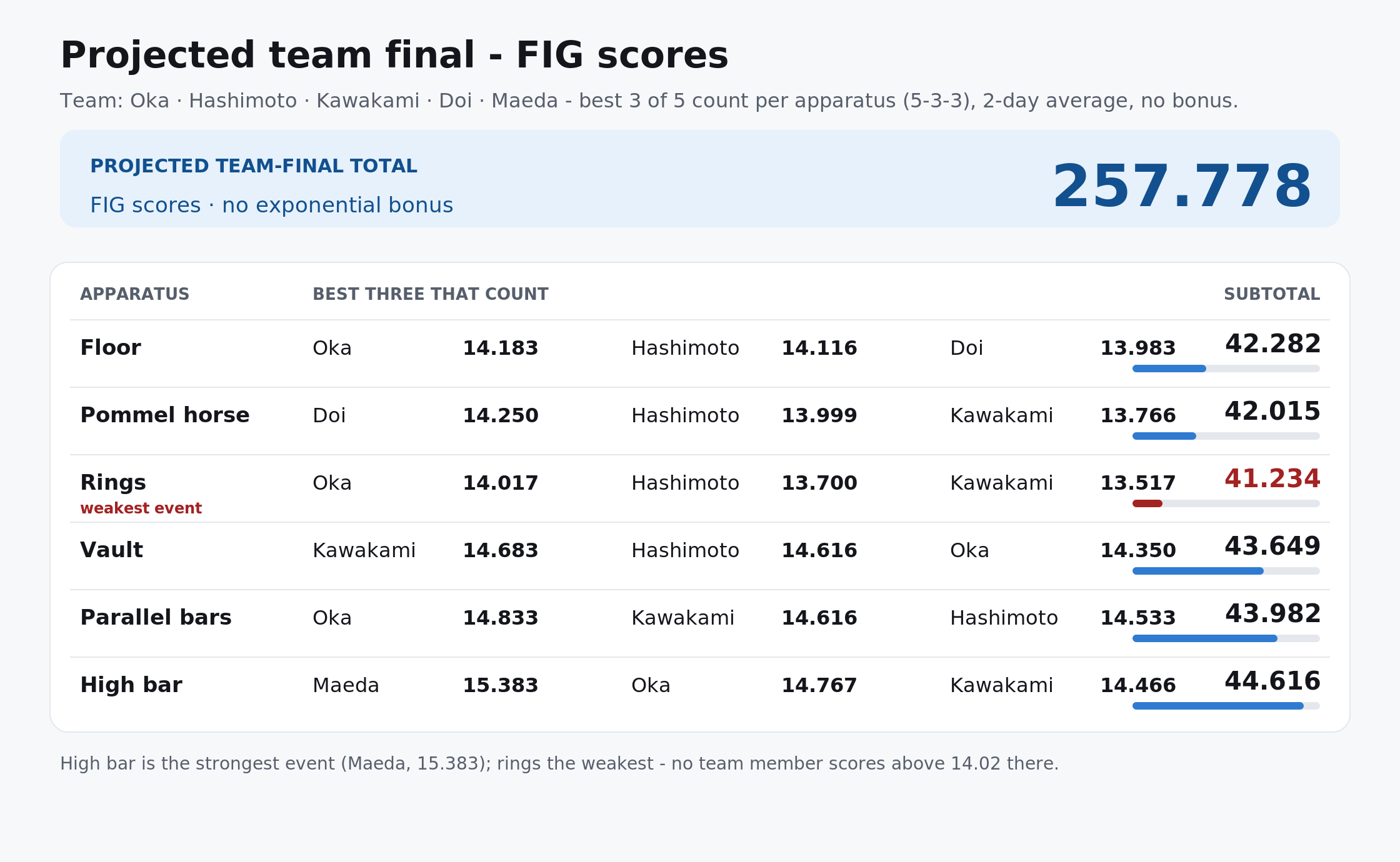
Based on a simulation from 2 days of competition. May not be the lineup seen at Worlds.
There were a couple of areas where the machine initially made an error. It initially flagged PH as the weakest event, which is wrong. I asked why, and it said something to the effect of “Oh sorry, I didn’t look at the numbers; I just assumed PH would be the worst event because it usually is.” The machine probably read too many articles on USA MAG written by Nancy Armour. I also had to remind it that Doi did not outscore Tsukiyama internationally on PH. It had already settled on Doi, so it didn’t change its mind about the team. It was a close one it seems. This is a demonstration that totally outsourcing your brain to AI is a mistake. It can be a coworker to help with the boring stuff, but it works best if one also has some domain knowledge. I’m sure the Japanese MAG superfans out there will find other details they question.
What this selection process does well is narrow the field to the real contenders. In gymnastics (and in life), it is both easier and more important to avoid the really bad decisions than it is to land on a single “most excellent” one. Whatever problems the USAG selection process has (and there are a few), it should be able to select a reasonable team and also avoid a disaster. A team that is a few tenths off may finish a little lower than another one on a given day. A really bad one could mean not going to the Olympics.