2026 MAG Nationals by the Numbers

This is actually Tucson, but close enough. Photo by author.
'It's tough to make predictions, especially about the future.' - Yogi Berra
In the case of the 2026 MAG Nationals, it’s actually not that hard. I predict Frederick Richard will win the All-Around and make the World Team.
With only one relatively sure thing, the rest of it isn’t as clear.
There are always surprises.
Eater Phoenix list of 38 best restaurants
These are all based on 2026 Senior scores. Not every athlete has data, so if someone is missing, that’s why.
I considered NCAA data, with the understanding that the E scores are inflated relative to elite domestic and international scoring. NCAA data makes up the majority of the set and has some correlation with how the athletes will perform. Sam Mikulak seemed to be a surprise in 2012, which he should not have been to anyone who looked closely at his NCAA record.
I did not discuss athletes who qualified through the Jr. ranks, although athletes in that category have made event podiums and even made Sr. National Team.
Comparing athletes with 10 data points to those with 1 or 2 adds to the uncertainty, as does athletes competing events for which they have no 2026 data.
The wild cards are athletes with upgrades (Media reports indicated Richard and Leykin will have some, and I doubt Nederoscik is going to show up with a 5.1 D score routine), and athletes with almost no data (Colt Walker). That guy has come out of nowhere before, so don’t count him out.
All scores (D and total) refer to what the athletes have competed so far this year, not what they have planned for Nationals.
This also does not account for limitations due to injury.
The following charts mix FIG, USAG, and NCAA meets. I know these are NOT equivalent (NCAA E scores tend to be inflated) but the purpose is to give a visual of who is in the mix, NOT to provide an exact ranking or be part of any selection simulation. Use the numbers and rankings only as a guide. Scores with more decimal points came from meets with larger judging panels.
Once the first competitor touches the first apparatus, none of these tables mean anything and the athletes will write the story.
All Around
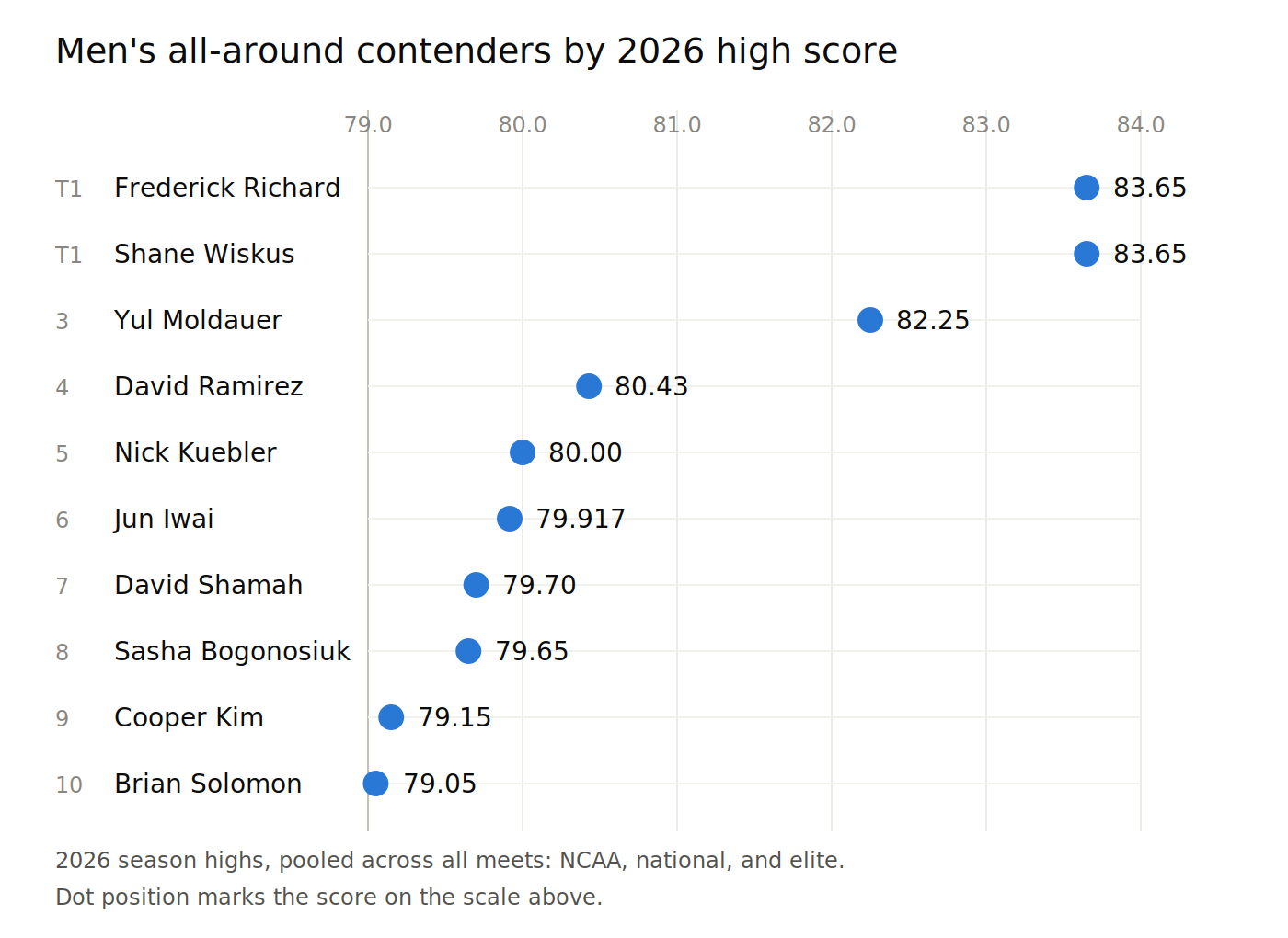
I’d put my money on Fred. He has the difficulty advantage and will benefit most from the bonus program. The only men in the field with AA D score totals over 30 are Frederick Richard, Yul Moldauer, and Shane Wiskus. On the other hand, Fred may incur a total of 0.6 neutral deduction if he competes in his personal uniform design. Richard should be coming in as the favorite, but he’s not so far ahead he can fall/make large errors multiple times and still win.
The chase pack - Hasan Aydogdu, Kyler Hinson, Landon Simpson
Don’t write off (if these people do all six) - Fuzzy Benas (has the difficulty, not sure if he will compete AA), Taylor Burkhart, Josh Karnes, Danila Leykin
Floor
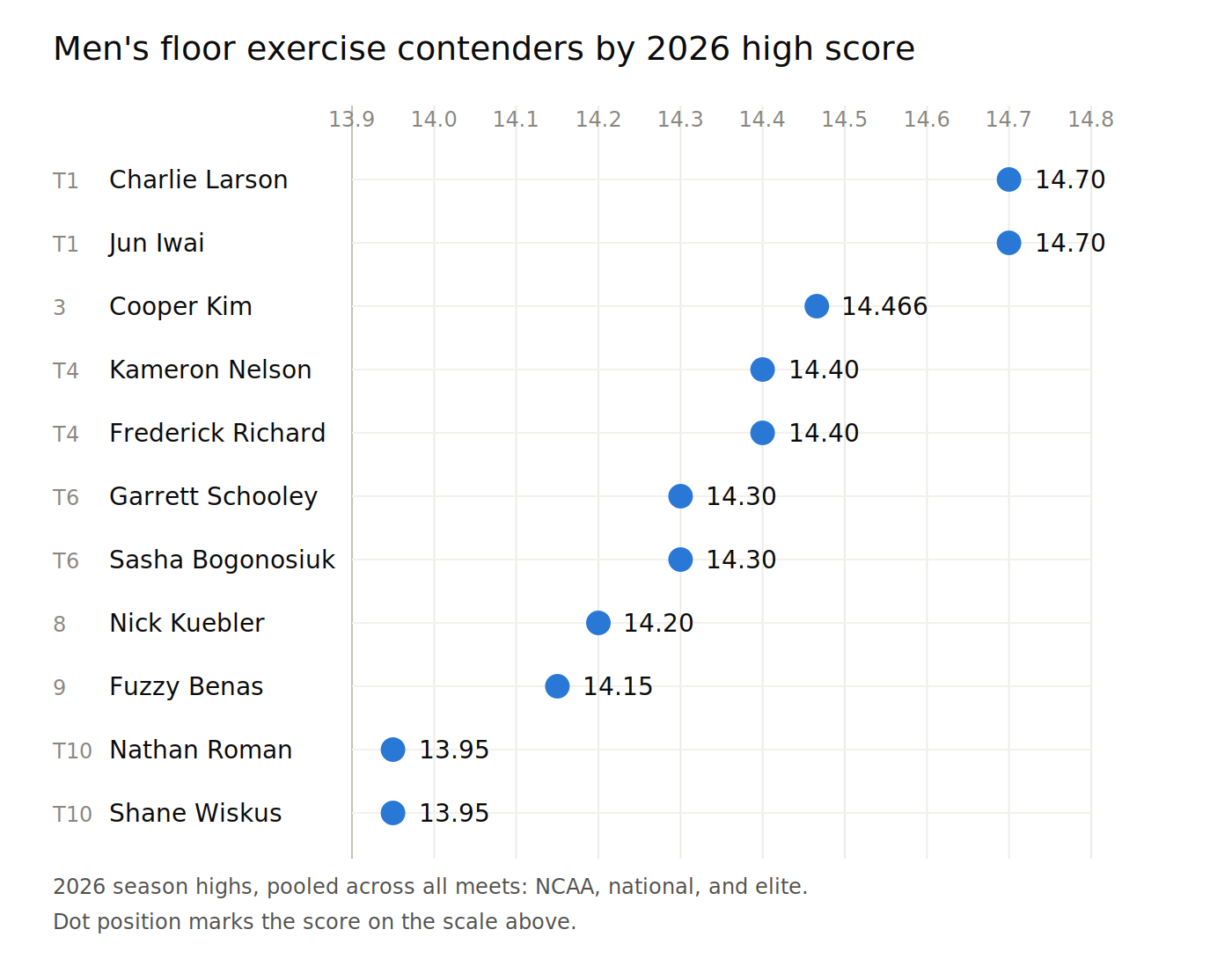
I’d put my money on Nelson, as he’s capable of one of the highest difficulty floor routines in the world and is a World finalist on that event. If he does his most routine, he will benefit from the bonus even if his routine isn’t perfect. On, the other hand, his last outing wasn’t great. But if he hits with decent execution, he wins.
The chase pack includes Alex Nitache and Brian Solomon.
Charlie Larson, Ben Letvin, and Cooper Kim probably have the most interesting routines.
Larson has upgraded since last year’s Nationals. He now has a 5.5 D score, only a point behind Iwai’s 5.6
Don’t write off Yul Moldauer - he has a history of being good on floor and is World medalist and Olympic finalist on the event. Keep an eye on Nathan Roman; he is a PB leader, and I see him down for all six. This could matter.
Pommel Horse
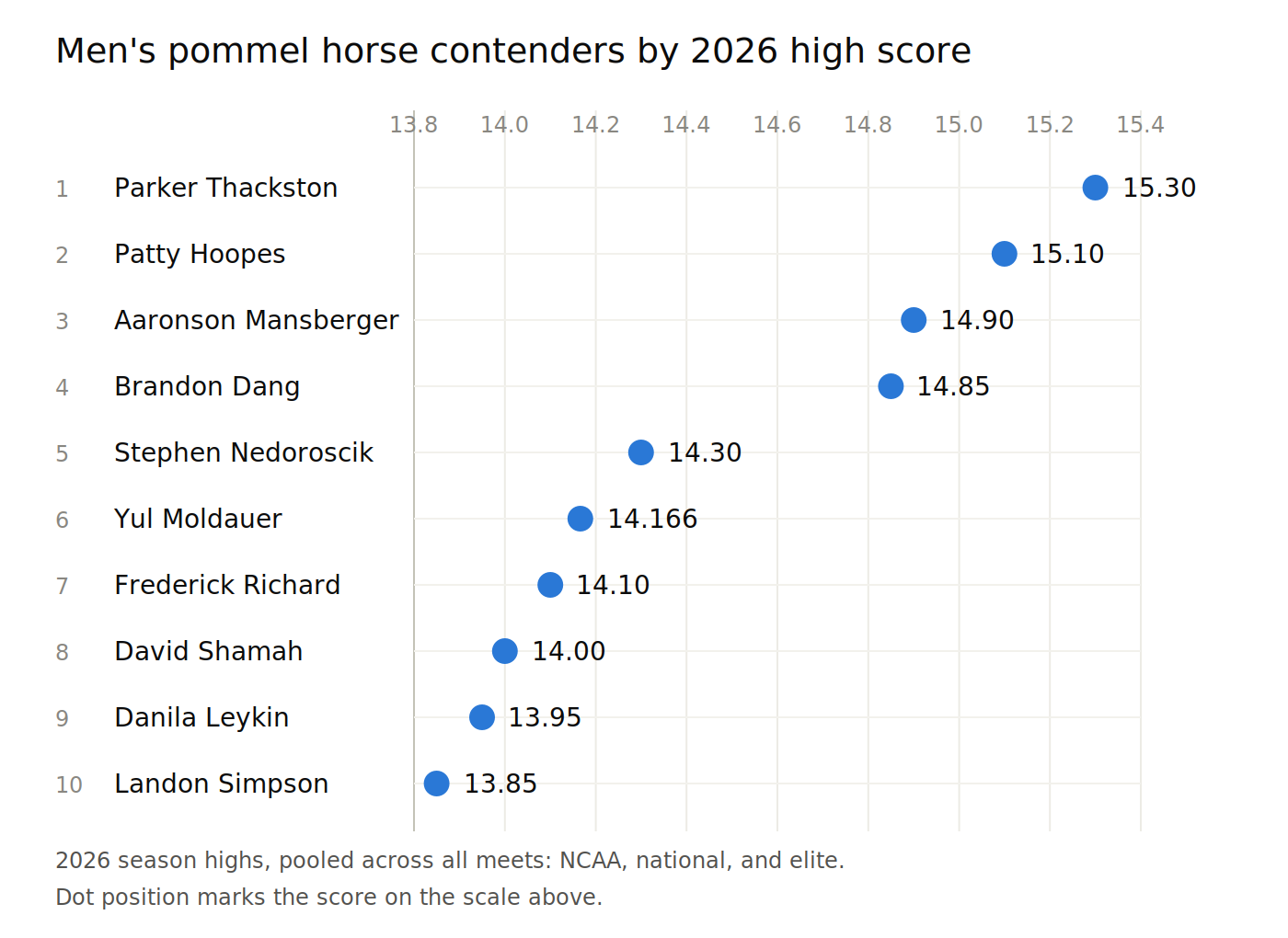
My money is on Hoopes, but with this one, who knows. On any given day, even the best of them don’t perform to potential on horse.
This even is absolutely dominated by the top 4 + Nedoroscik. The top 26 scores are from these 5. The Nedoroscik routine had a 5.1 D score, and as mentioned earlier, he will likely show up with an upgraded routine.
This event could be a key one for Yul Moldauer’s World team chances. He’s the first one to show up in the list of high scores that isn’t part of the 5 horseman.
Don’t write off - Josh Karnes. He competed a 5.8 D score this year. If he hits something close to this difficulty, he’s in the mix.
The pommel specialists will benefit from both high total scores and bonus. This gives them a leg up when it comes to staking a claim on the highest scoring team.
Still Rings
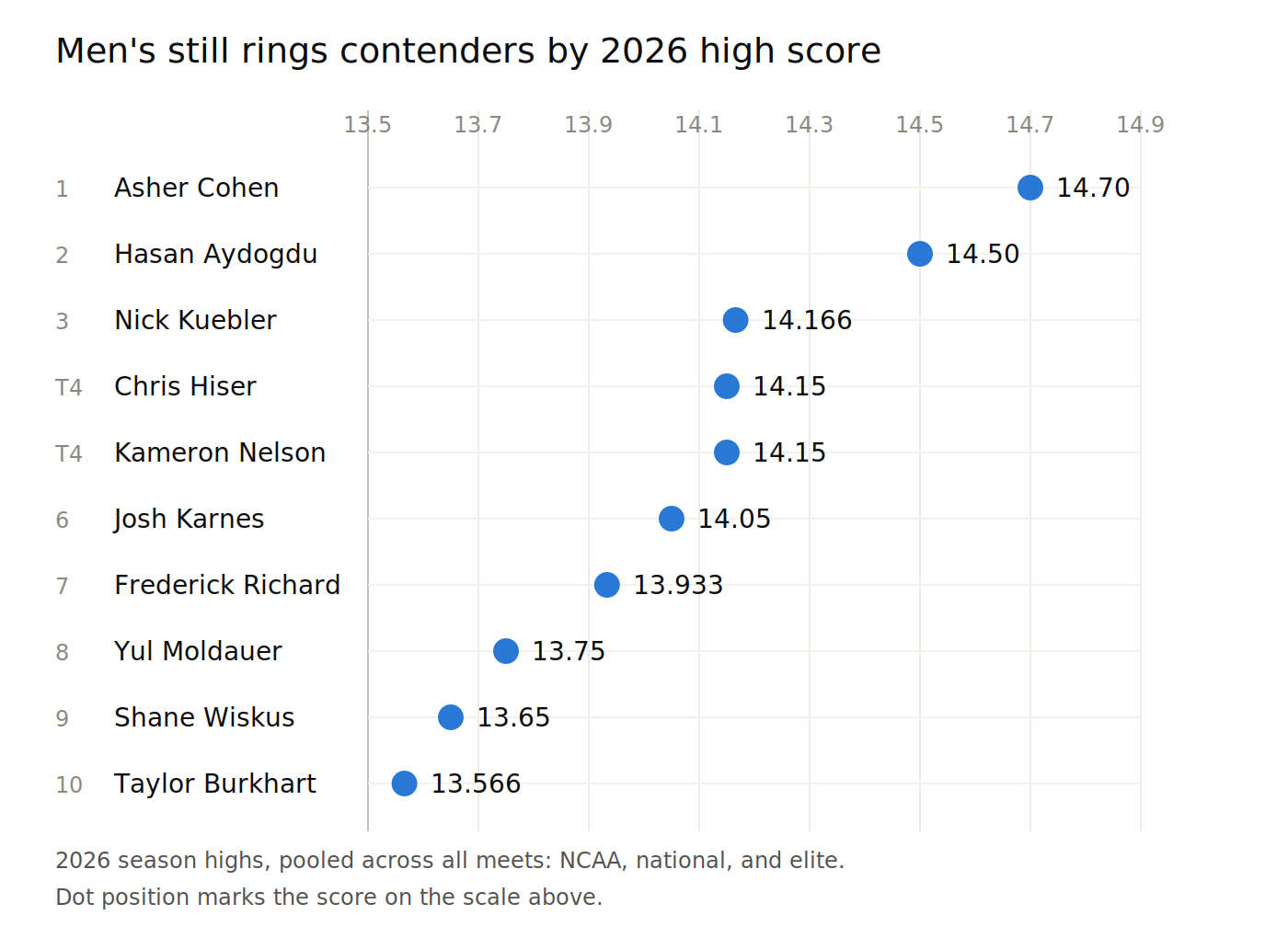
My pick is Asher Cohen. It would be nice to see both Cohen and Hiser on the podium for Nebraska to honor Jim Hartung’s memory.
With the withdrawal of Donell Whittenburg and Asher Hong, this is probably the United States’ weakest event, and could be a key event for others trying to make their case for Rotterdam.
This event is key for Kameron Nelson, as he has strong floor and vault, in addition to strong rings.
A single event rings specialist being placed on the World team is less likely than a single event pommel specialist getting a spot. The rings specialist D scores in this field top out in the mid 5s, and because of that, rings specialists don’t have as much opportunity to earn bonus. In terms of absolute FIG scores, in this field PH specialists outscore rings specialists. Not saying it isn’t possible, just not as probable as a PH specialist being chosen.
What I can see happening is Hasan Aydogdu, Asher Cohen, or Chris Hiser making National Team even if they need a discretionary spot to get there. The US does have a weak spot on rings, and I can see the committee wanting to foster more ringmen.
Vault
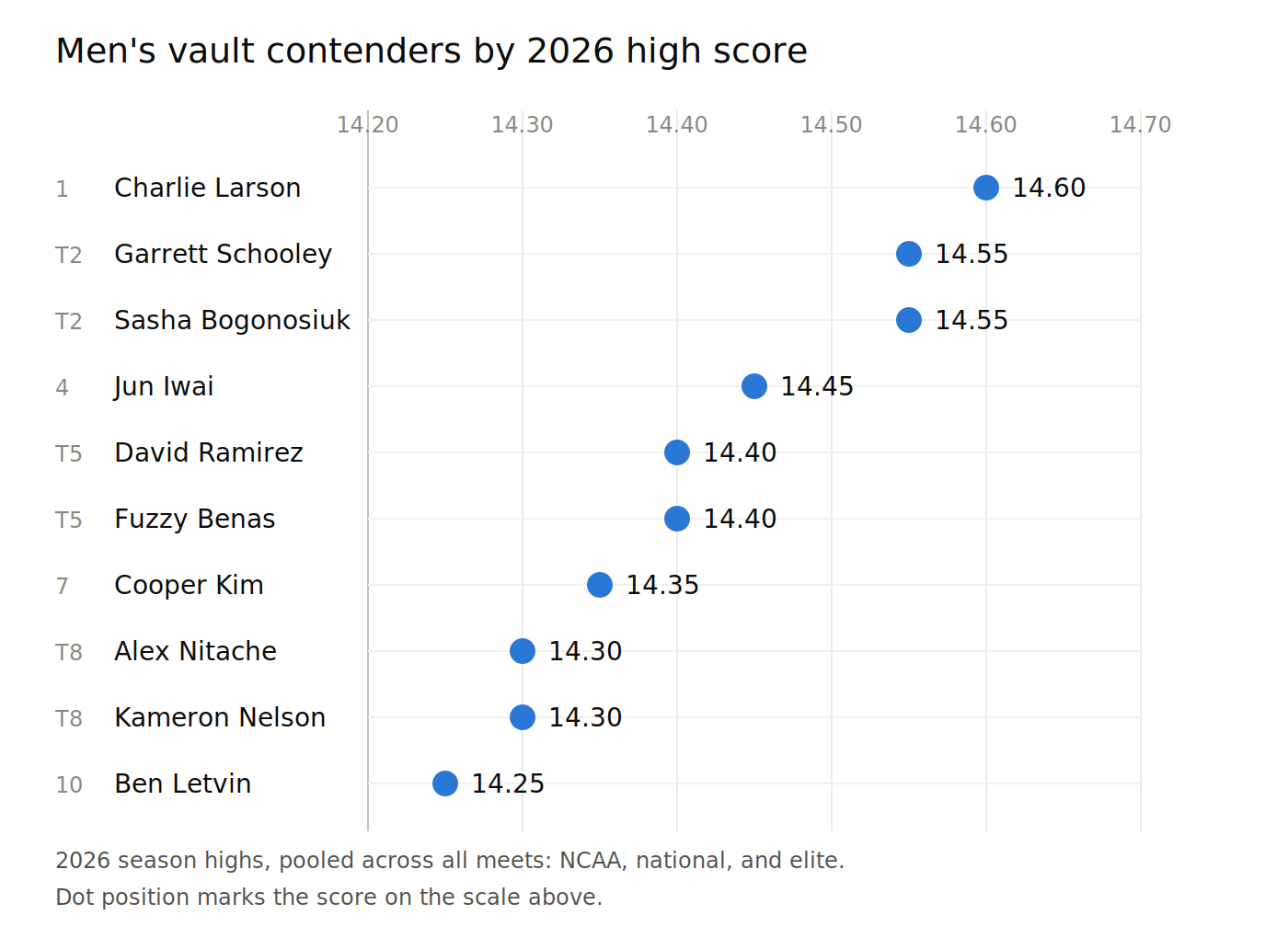
Putting my money on Nelson for the National title, because all he has to do is put two halfway decent vaults to his feet, and he wins. The only other man to do two vaults this year are David Ramirez, Garrett Schooley, and Sasha Bogonusiuk.
Others who have done two vaults (within the last 2 years) include Taylor Burkhart, Fuzzy Benas, Cooper Kim, and Alex Nitache. Walker and Karnes have done so in the more distant past. That third place could be won by someone with a second vault with a 2.8 D score.
Ben Letvin is here representing GymACT.
There could be someone else who shows up with a second vault that no one saw coming. It’s happened before (David Sender showing up at Nationals with a Yurchenko double pike).
“Contender” is doing a lot of work here. The US Title requires 2 vaults. The graphic is there partly to gave some indication of how candidates for Worlds/National Team may do). Anyone with a 4.8 vault can get close to 14 if he hits it, and that is quite a few people that don’t show up on the chart. The only competitors who have competed vaults of greater difficulty than 4.8 in 2026 are Taylor Burkhart (5.4), Kameron Nelson (5.2), Garrett Schooley (5.2).
Burkhart must have a Li Xiao Peng based on the D score. Not sure if we will see it in Phoenix, as the total score was only 12.633. If he competes it, it likely be the hardest vault done at Nationals.
Parallel Bars
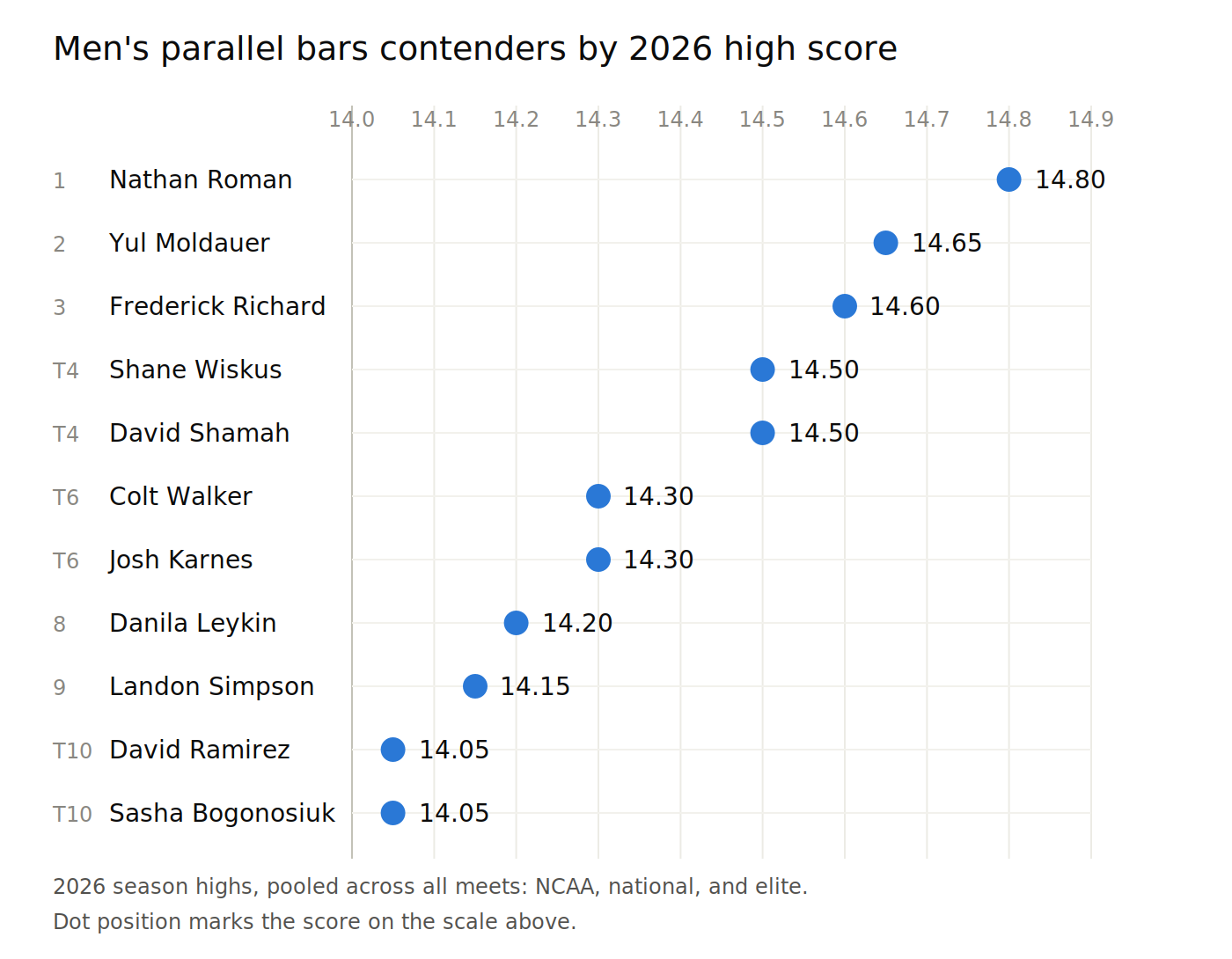
Bet Nathan Roman.
Roman, Yul Moldauer, Frederick Richard, Shane Wiskus, and David Shamah dominate here. Josh Karnes has the difficulty to be right in there if he hits.
The chase pack includes Sasha Bogonosiuk, Fuzzy Benas, Landon Simpson, and Asher Cohen. Asher Cohen has a decent PBars, which could help him in combination with his rings. We have a lot of good PB workers, but if Cohen rocks both rings and PB he could be in the picture.
Based on past history, Colt Walker could show up among the leaders.
High Bar
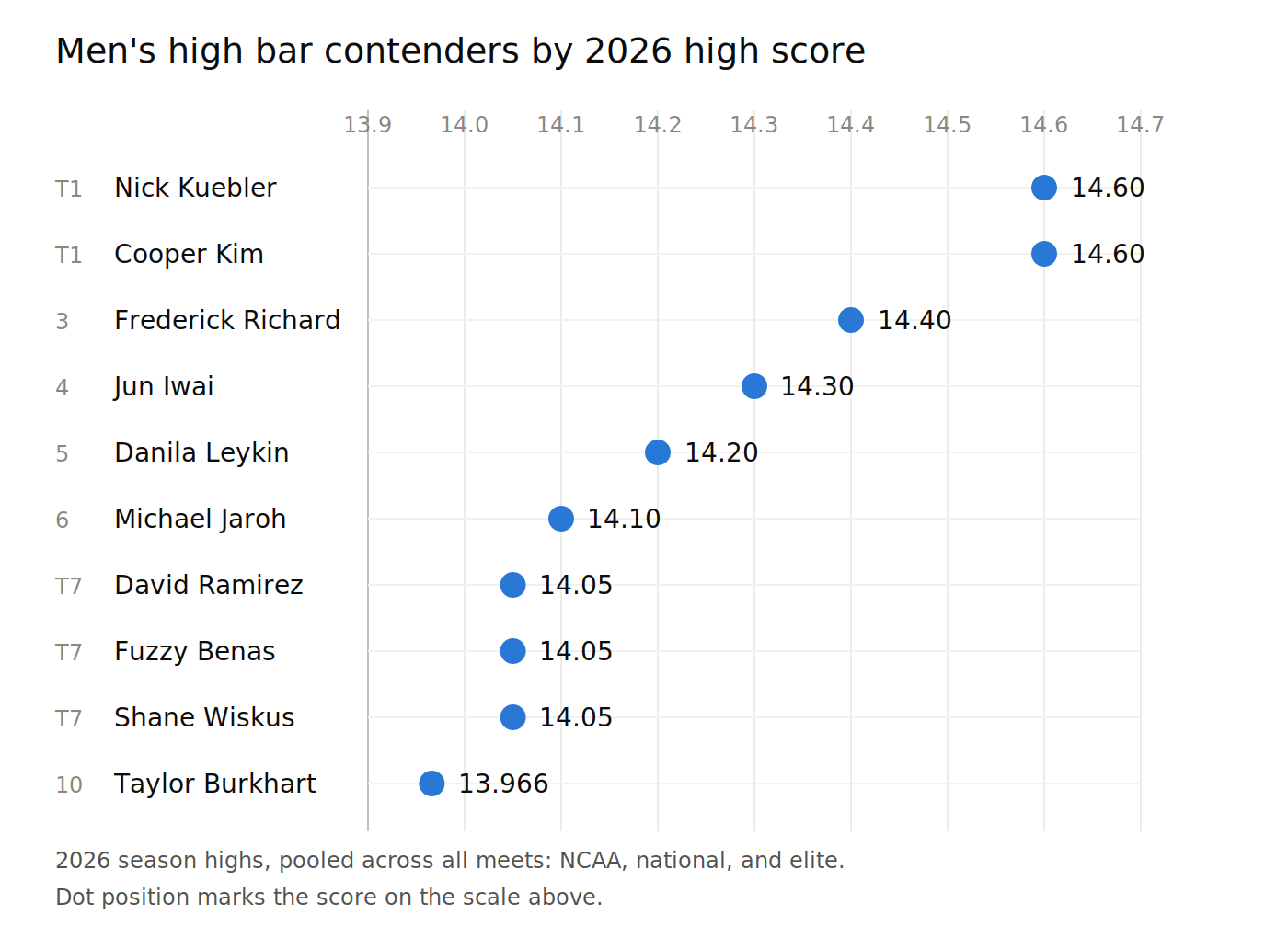
Pick - Danila Leykin, because why not. No guts, no glory.
Cooper Kim happened to have one really high score. It could be a one-off, but it’s worth keeping an eye on him to see if he can repeat it.
The interesting thing about this group is the only competitor with a D score of 6 or above who shows up is Danila Leykin. Crew Bold (6) and Josh Karnes (competed 6.3 once) didn’t manage to break 14.
Hasan Aydogdu, Alex Nitache, and believe it or not, Yul Moldauer do pretty well compared to the rest of the field. This could be key for Yul, as there could be some configurations of the World team that may use him as the third man in a team final. He needs to hold onto that bar.
World Team Speculation
USAG Gymnastics Men’s World Team 2026 selection procedures
For those interested in seeing the criteria in action, I test-drove them on a Japanese competition
For a team to be automatically chosen, the top 5-3-3 team without special bonus, with special bonus, and D score alone have to match. The chances of this happening are small.
The straight FIG teams will likely differ by tenths, which can come down to chance or noise. The high D score teams will all likely include Josh Karnes and/or Danila Leykin, so unless those athletes deliver high total scores, the 3 teams will not match, and it will go to the selection committee.
Anyone who wins the all-around and finishes top 3 in 3 events will automatically qualify. The most likely person to do that is Richard, but even that is unlikely.
There is at least one confusing statement. The criteria don’t indicate whether top 3 on vault means actually winning the event title or just getting the highest total score of the meet, and these may not go to the same person. IF top 3 means winning the title, it makes the auto lock that much harder because most contenders only do one vault. I think it means top single vault score, because that would make the most sense, but I don’t know.
If I had to guess it would be Richard, Moldauer, Wiskus, a PH specialist, and some other guy. Maybe Nelson - if he manages to hit. I’m going with Hoopes for PH, but who knows.
If the choice goes to discretion, which it probably will, teams with a pommel specialist have the edge, because “it worked before”.
Dark horse to make the team - Nick Kuebler. Dark horse team - Kim, Kuebler, Moldauer, Richard, Thackston.